Why we need technology governance? - Part 2
The problems of an ungoverned technology stack, like sprawl, support cost and upgrade surprises, and why a shared and owned list is the answer.
Why we need technology governance? - Part 2
Nobody wakes up in the morning and decides to create a mess in the technology stack. It happens slowly. A team needs a library, another team needs a similar one, a third team brings a new framework because a blog said it is the future. Each decision is small and reasonable at that time. In the previous article, we discussed what is technology governance. In this article, we are going to see the problems which come when we don’t have it, and why it is worth the effort.
TL;DR Summary
- Without governance, every team picks its own technology, and the organization pays for it later with more variants to learn, support and secure.
- It is hard to answer simple questions like “which frameworks do we use?” or “which of them will be retired?”.
- New joiners and teams don’t know what is preferred, so they decide with guesses.
- Reuse is reduced, because everybody solves the same problem with a different tool.
- Governance gives a controlled way to bring a new technology in, and a clear way to move an old one out.
- It is a trade-off between the freedom of the teams and the cost of the organization. A light and visible process gives the best of both worlds.
Common Challenges
Let us discuss the key concerns when we don’t have a technology governance,
Technology sprawl
When every team chooses on its own, the number of languages, frameworks and libraries grows without any control. Two teams may use two different libraries for the same job, only because they didn’t know about each other.
Cost of support
Each technology needs people who know it, someone who patches it, and someone who answers the questions at the middle of the night. The more variants we have, the more people and time it needs. The cost is invisible at the time of the decision, and it is visible only at the time of the incident.
Upgrade surprises
Technologies have a life. Some are well supported for years, some are going to end of life next year. If nobody tracks it, we come to know about the end of life only when the support is gone, and then the migration is an emergency, not a plan.
No clarity for the teams
A team which designs a new feature asks “can we use this?”. Without a shared list, the answer is “ask somebody”, and different people give different answers. The decision is delayed, or taken with a guess.
Hard onboarding
A new joiner needs to understand the stack. Without a guide, he learns it from the code of each application, and learns the wrong things too, like old technologies which everybody wants to remove.
Low reuse
When every application has its own choice, the components, the knowledge and the tooling can’t be reused across the applications. It is a hidden cost for every new product.
What happens if we don’t act?
The chain is simple, and it ends with the business,
- The number of technologies grows, so the support and the learning cost grows.
- Old technologies are not removed, because nobody knows how many applications still depend on them.
- Upgrades are done as emergencies, so they take more time and bring more risk.
- The teams spend time to debate the choices again and again, and the delivery is slower.
- The customers feel it as slower features and, at worst, as outages caused by unsupported technology.
We are always reactive. We discover the problem at the day when a technology is out of support, and then it is too late to plan.
Why is governance the answer?
In order to avoid the sprawl, to control the cost of support, to plan the upgrades and to give the teams a clear answer, we need a shared and owned list with a status for each technology. The following diagram depicts the difference,
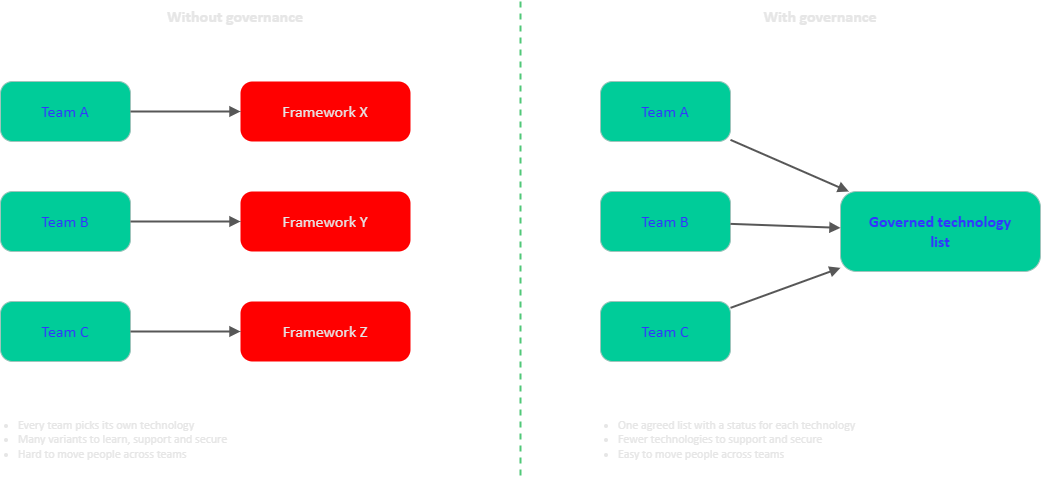
Let us see what we get,
| Problem | Without governance | With governance |
|---|---|---|
| Which technologies do we use? | Nobody knows exactly | One list with a status for each |
| Can I use this technology? | Ask somebody and get different answers | Check the status, or talk to the owner team |
| What will be retired? | We find out when the support ends | Retire is planned and visible |
| What should a new joiner learn? | Whatever is in the code | The preferred technologies |
| How to bring a new technology? | Just start using it | New, then assessed, then decided |
What about the freedom of the teams?
A common worry is “this will slow us down”. It will, if governance is a gate with a long queue. It will not, if it is a light process. The default status New only says “talk to us before you use it”, it doesn’t say no. The assessment is done in collaboration with the community, and the result is published, so the next team doesn’t need to repeat it.
Must Consider: Governance is successful only when the teams see it as help. If it is slow or hidden, they will bypass it, and we are back to the beginning.
Wrap up
In this article, we have looked at the common challenges without technology governance, what happens when we don’t act, and why a shared and owned list is the answer. Thanks for reading this article. In the next article, I will walk you through how to implement technology governance: the ownership, what to include in the list, and the review cycle.
Related Posts
How to build and run a Tech Radar? Stages, categories and the assessment - Part 6
How to build and run a Tech Radar with eight lifecycle stages, the assessment steps, the categories and a run checklist.
How to implement technology governance? - Part 3
How to implement technology governance with ownership, a clear scope, version rules, a default status and a review cycle.
What is a Tech Radar? - Part 4
What a Tech Radar is, how it is created from the technology list, and how to read the rings, quadrants and dots.