Why we need a Healthy API Management Solution?
The common challenges of an API program across the API lifecycle, and how API management and an API management platform help to keep it healthy.
Why we need a Healthy API Management Solution?
Almost all modern applications are built on APIs these days. They are the abstraction of business and technical elements. APIs are built on one key principle which is to reuse services and not just to reuse business capabilities without duplicating the functionality, and also to reduce development costs.
In the previous article, we were discussing the API economy, which provides a good overview of the importance of participating in the API economy to gain a competitive advantage for a sustainable business.
In this article, we are going to discuss some of the API program challenges and also how to manage them well with the process, practices and tools.
Common Challenges
APIs are inherently hard to develop and release, nothing will come with them free of cost. Similar to other software applications, API has its own lifecycle and it has the following phases,
- Designing and Planning APIs
- Developing APIs
- Testing APIs
- Securing APIs
- Documenting APIs
- Versioning APIs
- Deploying or publishing APIs
- Making APIs Discoverable
- Monetizing APIs
- Observing and Managing APIs
- Scaling APIs
- Retiring (Sunsetting) APIs
We must travel through these stages iteratively. Each stage is important to one another in creating and maintaining a healthy API.
Let us discuss the key concerns why we need a really healthy API management solution.
Customer Experience
Our APIs should enable the rapid adoption of new applications and seamless experiences across different channels, which intern helps our customer (app developers and partners) continues to move on their customer needs on time.
Most importantly, our APIs should provide high levels of responsiveness and convenience to our customers and this is one of the big challenges we must address for better API business.
Scope
A major challenge in the operation of a healthy API management program is to achieve the appropriate level of central control. As the program matures, it takes into the next level of challenge. In simple term, this challenge is mainly around how we are going to centralize all the controls while governing APIs when the landscape is expanded and the program mature over the time.
Scalability
It is another major challenge in developing and maintaining a healthy API management program, it has to address the changes in scale over a period. As our API landscape increases, we might encounter a lot of issues with the increase in teams involved and the number of APIs created by those teams become a big challenge for management and maintenance.
The operation process will also change as the program matures. Tools for tracking a small set of APIs created by the same team in one physical location is very different from the tools for tracking hundreds or thousands of API entry points scattered across multiple time zones and countries. Mostly, scaling will be a challenge in these areas in terms of teams, governance and technology.
A healthy API management solution can solve scalability challenges by providing ease of access and reducing the technical load across the API lifecycle.
Security
Security is another challenge when an organization opens their digital assets outside the world where almost anyone can access. Security is a critical element and all sorts of measures must be taken to protect sensitive data, ensuring that permissions are properly managed on every resource. Without a healthy API management solution that provides visibility and consistency, security monitoring becomes extremely difficult at an enterprise level.
What is API Management?
API management is a process to design, document, distribute, control, monitor and analyze APIs that connect applications, business processes and data in the enterprise and cloud scales. It is about centralizing control of our API programs throughout their life cycle. API management allows organizations to create both public and private APIs, monitor their activities and ensure API customer experience are being met with the right expectation.
The key benefit of using an API management tool is to solve all major challenges of an API program like central control, scale, security, etc.
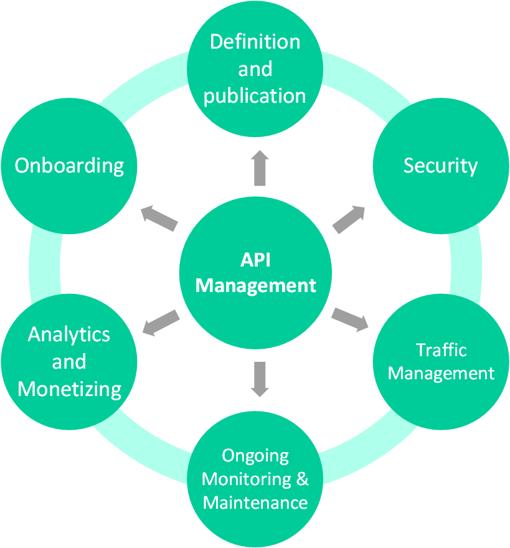
API Management Platforms
An API management platform is a tool that provides the seamless and end to end implementation of the API management process. It benefits organizations to centralize control of their API integrations, while ensuring that they consistently meet high performance and security standards.
Today we have lots of API management platforms in the market and the following Gartner quadrant list out the market leaders and other rising stars in the APIM platform markets.

API Management Platform features
An API management platform must have the following features,
Developer Portal
A developer portal provides the API catalogue, documentation and a playground to play with APIs.
It is one of the common API management practice to have the developer portal and it is an integral part of simplified collaboration across teams and enable developers to easily navigate, build and test their APIs.
An API Gateway
The API gateway is an API proxy that resides between the API provider and the API consumer. This is a façade with an API interface that represents a complex sub-system and it acts as a “front door” for all our back end systems. It can handle request routing, authentication and authorization, other security practices, rate limiting, API transformation, scaling and monitoring, etc.
The API gateway decides how clients can communicate with APIs through policies and also perform the above functionalities through these policies.
API Life Cycle Management
As part of new digital transformation strategies, API integrations enable scaling up the business operations. It is the most essential feature of the API management platform and it helps organizations to manage the API’s life cycle right from design to deployment and scaling.
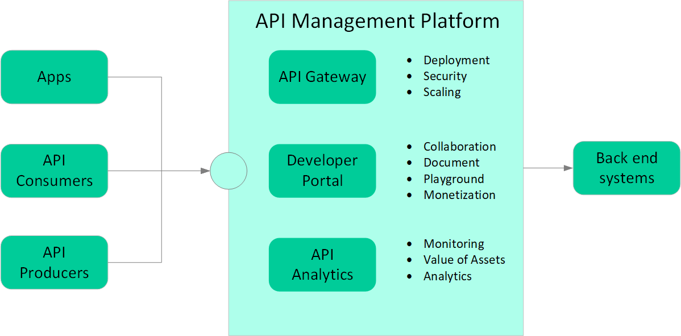
Some of the API management platforms provide the following additional features to enhance the overall API management solutions.
Analytics
Business owners, application developers and administrators should understand what is going on with the APIs and this feature provides insights for business owners, operational administrators, and application developers enabling them to manage all aspects of a company’s APIs and API programs. Most importantly, it helps organizations to understand the values of their business assets.
API Monetization
This feature enables API providers to create their own business model for their API business. It helps API providers to package, price and publish their APIs so that partners and developers can purchase access or take part in revenue sharing.
Use Cases
An API management platform is an essential element for an organization and it is the key enabler of digital strategies. Here are few use cases where API management platforms empower the enterprise to use their business assets and sustain their success in the API economy.
- When an organization wants to support their digital transformation - For example, when an organization has a strategy to integrate multiple internal or external APIs to create a new business or expose the internal APIs to their consumers(data or business as a service). Managing the whole thing is cumbersome and ineffective without the right automation tools. An organization can accelerate their API business by using the right API management platforms.
- B2B integration - When an organization wants to integrate with its partner to build new business, the API management platforms provide the necessary process, tools and standards to enable seamless integration with one or more parties.
- Seamless Security- It is equally important to apply security on digital assets as to how they are easily accessed by consumers. The API management platform acts as a front door and applies all possible securities to all digital assets.
- Compliance and Regulations - When there is a demand to apply compliance and regulations (GDPR, etc.) on multiple APIs or applications that are consuming APIs accessing/moving a huge volume of data, the API management platform will help the organizations to centralize the compliance and regulation, control in one place.
- Accelerating App Development - When an organization or their customer want to be ahead of the market competition, they should quickly deliver applications in the market. The API management platform enables developers to improve the application development productivity, whereby developers leveraging the organization data and business functionality.
- Maximize the Business Value - One common issue across the business is the organization failing to understand the growth of their business assets’ value or optimizing it. This is an absolute blind spot for most of the organizations as they stick to one business model that may be inefficient for them as well their customer. The API management platform can help organizations to understand their business assets’ value and optimize through Analytics and create the right business model for their customers.
Conclusion
All enterprises want to do sustainable business in the API economy and will come across some common and unique challenges during their API program journey. It is very important to create and maintain a healthy API management solution and API management platforms help an organization to achieve this. Thanks for reading this article, in the next article we will discuss the Azure API Management platforms.
Related Posts
Azure API Management Platform for Your API Program
How Azure API Management provides a developer portal, API gateway, lifecycle management, analytics and monetization for an API program.
Welcome to API Economy
How APIs create a value chain from business assets to platform APIs, consumers, applications and API monetization models.
API Gateway pattern - one front door for many services
The API Gateway pattern explained through routing, authentication, rate limiting, aggregation, caching, Azure API Management policies and ownership boundaries for practical guidance.