Welcome to API Economy
How APIs create a value chain from business assets to platform APIs, consumers, applications and API monetization models.
Welcome to API Economy
Nowadays, APIs are ruling the internet and business worlds, it’s expected to continue in the future as well. APIs are the main driving forces of modern business growth and the backbone of almost all the business applications that exist in the universe. We are living in a very competitive world, disruptive innovations (especially for startups) and time to market are the primary things required to do sustainable business in this competitive world. APIs are enabling us to do sustainable business and early adopters always have a competitive advantage.
APIs are great connectors of different technology ecosystems and organizations which creates new opportunities like profitable partnerships with other organizations by consuming other’s data or selling data to others or white labelling of APIs. They also help organizations to create their ecosystem.
APIs are simplifiers, they help to achieve the time to market and improves the operational efficiency, which intern enables innovation for their consumers: with the help of APIs, consumers can create new products or quickly turn their project ideas into products.
APIs are gatekeepers, they abstract or hide the complex business processes, infrastructures, data management, data protection (with regulation, compliance), overall security, and operational management behind the wall.
The mantra for success is to derive our business digital strategy with APIs, it will allow us to make sustained business. Now, this is your chance, it is never too late to start adopting APIs if not already.
To get a better understanding of the API economy, we should understand the API value chains and business models, in this article we are going to discuss these topics one by one.
The API Value Chain
The value chain is a continuous process of transformation, such as a factory assembly line and it extends across all industries to allow different organizations to be involved to create value. Each organization is dedicated to a particular transformation task and deserves its place in the chain. The API value chain is a software-driven and automated specialization of the value chain. The value chain is formed as an end-to-end path, as shown in the following image as a blue line. The value increases through the value chain from left to right.
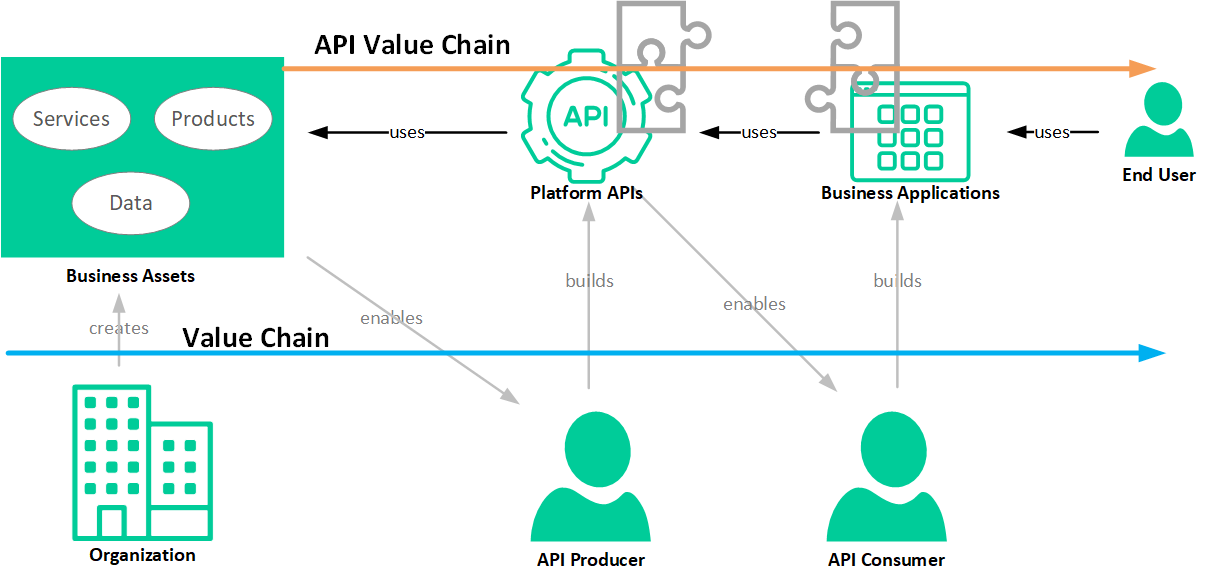
End-user starts using the application. The application consumes APIs, which intern uses Business Assets to deliver its functionality. The end-user consumption creates an API value chain from the Business Asset to the End-user, as shown in the picture above as an orange line. The value increases incrementally through the API value chain from left to right.
Business assets are the starting point in the API value chain. Business assets are the fuel for any business, and they can be any data or business function (services, products). APIs create a channel to expose our business assets to consumers, so organizations need to identify their business assets to expose, their value and target audiences to convert them into APIs products. To identify asset value and target audience organization can ask the following questions:
- What are business assets that can be exposed as APIs and what is the value to the organization?
- How does this benefit the API provider (API provider can be a third party or asset owner)?
- Who are the potential users of these assets, and how would the users get access to these assets?
- How does the end-user benefit from using these assets?
- How easily can the end-user access and use it?
Once an organization decides to open assets to expose, the API producer discovers opportunities, builds APIs to use these assets. API producers can be the same organization or other organization that consumes the business assets. APIs are broadly categorized into two, private and public APIs. Private APIs purely for internal purposes or integration with partners so private APIs are further categorized into internal APIs and Partner APIs. Public APIs can access these APIs to build their products or consuming them in the existing products.
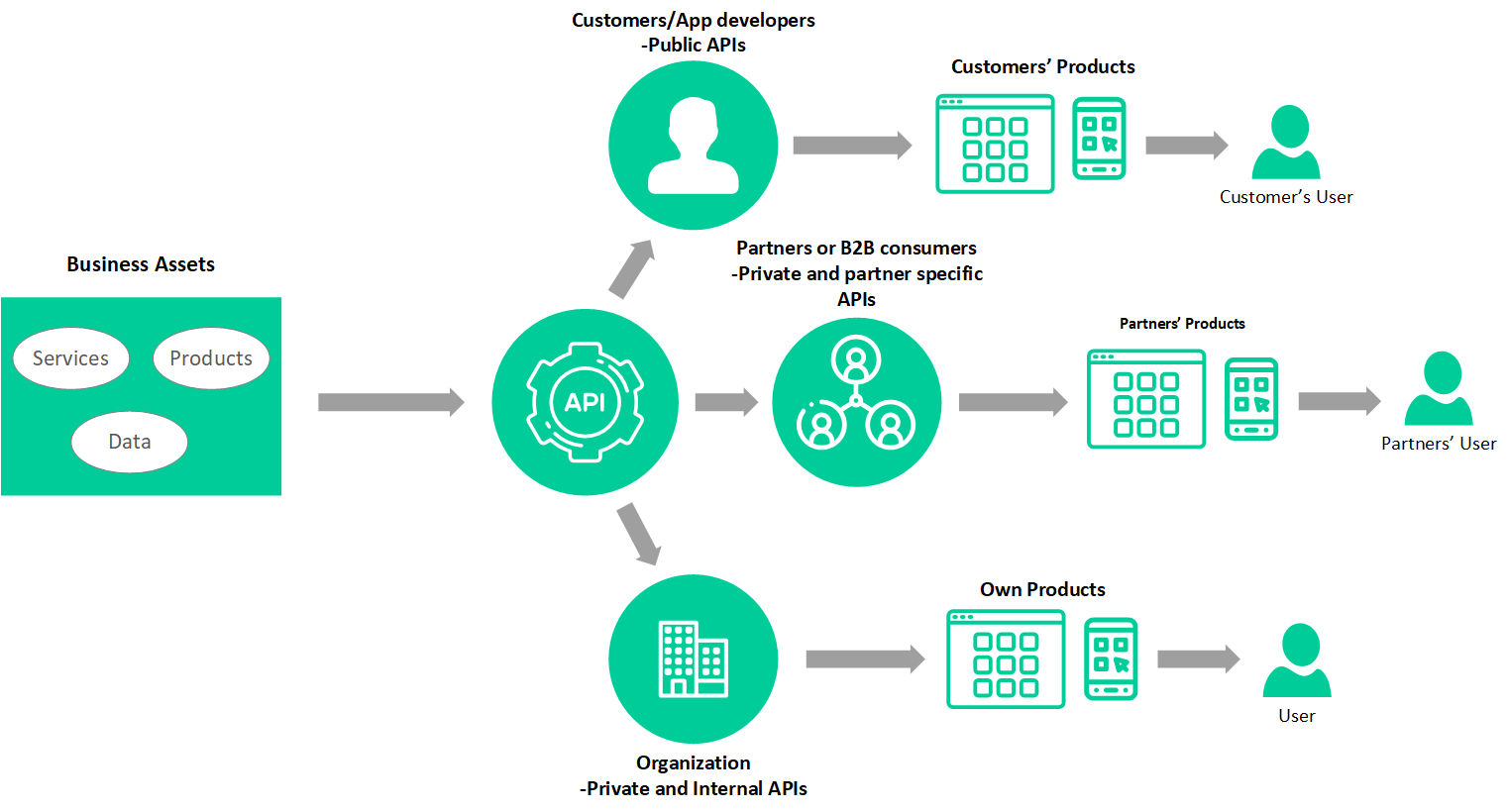
API Consumers build the business applications by using APIs for their end-users. Here, API consumers can be the same organization or parters or Application developers (who wants to build applications for their customers) depends on the API types.
End-users participate in the last part of the API value chain, they consume the business applications built with APIs.
The API value chain can increase from the starting to end (left to right), which means there are lots of additional API producers, consumers, and end-users who can participate both vertically and horizontally. As it increases left to right, it brings lots of business opportunities across different organizations.
Here are the few API value chain variations,
- Extended API value chain - two or more API producers will be involved horizontally to produce required APIs for consumers.
- Long value chain - in this variation more and more API producers will be involved horizontally to produce required APIs for consumers.
- Network value chain - in this variation, all three actors (API producers, consumers, and end-users) will be participating both vertically and horizontally. It creates a network across small value chains.
Business Models for APIs
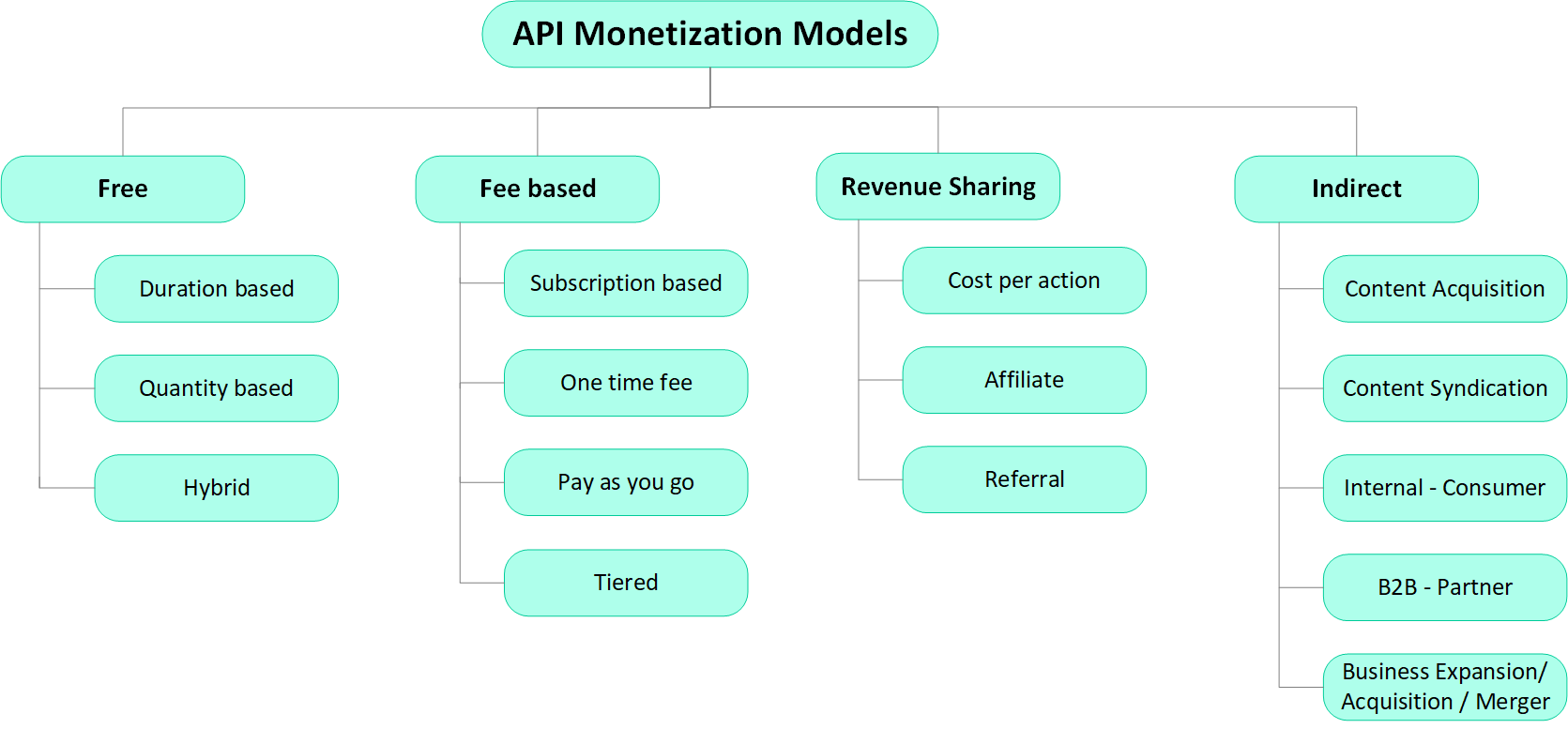
The API Economy enables organizations to expose their business assets with simple APIs to consumers and this brings lots of innovative ways to use the assets which intern creates more revenues, and this is called API Monetization. When API Monetization is a success, then it will have benefitted all parties involved in the Value chain otherwise there is no point in exposing the business assets so API monetization is one of the key elements in the API Economy. The monetization model should be selected based on the exposed assets’ value and usage. Broadly, the API monetization model is classified into four models and those are,
Free - normally this model is used to expose the low-value assets to try out for marketing purposes. Sometimes high-value assets are also included in this model. This model helps the organization to market through different channels and devices.
Fee-based - this model is used when exposed assets are of high value to the consumer. The consumer will pay for consumption depends on the pricing model.
Revenue Sharing - in this model organization shares the revenue earned through the use of APIs with the consumers, this encourages the consumers to expand their business applications and customer base to bring more revenue to the API producers and consumers.
Indirect - in this model both API producer and consumer mutually benefit. The benefits may not be a direct revenue, possibly they can get assets (data through the collection) or cost cuttings, etc.
The following diagram shows the different models of API monetization and sub-models.
Wrap up
The API economy creates an evolutionary impact on the way how business applications/products are built and consumed. The highest degree of reusability is an invitation to various business models to participate in the API economy. Now, it is time to call for action, “let us participate in the API economy to gain our competitive advance of sustainable business.”
Thanks for reading this article and I hope you found this information useful. We have discussed the importance of modern APIs and the API economy. It could be an eye-opening article if you’re new to the API economy. In the next article, we will discuss API program pain points and also how we can manage well with API management solutions.
Related Posts
Why we need a Healthy API Management Solution?
The common challenges of an API program across the API lifecycle, and how API management and an API management platform help to keep it healthy.
Azure API Management Platform for Your API Program
How Azure API Management provides a developer portal, API gateway, lifecycle management, analytics and monetization for an API program.
API Gateway pattern - one front door for many services
The API Gateway pattern explained through routing, authentication, rate limiting, aggregation, caching, Azure API Management policies and ownership boundaries for practical guidance.