What is enterprise integration and why do we need it? - Part 1
Why a mutual fund data platform needs enterprise integration, the common challenges and why a broker beats point-to-point connections.
What is enterprise integration and why do we need it? - Part 1
Almost every business application depends on other applications, data providers and downstream consumers. A fund data platform may receive a file from a fund manager, call an administrator API, validate a price, store a data point and then make the same information available to websites, factsheets and performance calculations. If every system integrates directly with every other system, a small change in one place creates a ripple effect everywhere else. In this series, I share the enterprise integration patterns which help us make these connections reliable and maintainable. In this article, we are going to see what enterprise integration is, why we need it, the common challenges and the difference between point-to-point integration and integration through a broker, an intermediary which stores and routes messages between applications.
Enterprise Integration Patterns series:
- What is enterprise integration and why do we need it? (this article)
- What are the styles of integration? - Part 2
- What are messages, commands and events? - Part 3
- How do messages flow from producer to consumer? - Part 4
- How to make messaging reliable and consistent? - Part 5
- What is event-driven architecture? - Part 6
- What is event sourcing? - Part 7
TL;DR Summary
- Enterprise integration connects applications, data and teams without making every component depend directly on every other component.
- A fund data platform integrates providers, ingestion services, validation, storage and many consumers with different release cycles.
- Heterogeneous technology, unreliable networks, changing data meaning and weak monitoring make integration difficult.
- Point-to-point connections are simple at first, but the number of interfaces grows quickly and changes become expensive.
- A broker, an intermediary which stores and routes messages, provides an integration boundary so producers and consumers can evolve more independently.
- Integration is not only a technical concern; it protects customer experience, operational response and the business value of data.
Why do we need enterprise integration?
Let us take our mutual fund data platform as an example. Fund managers, administrators and third-party vendors send fund static data such as fund name, International Securities Identification Number (ISIN), share class, currency, launch date, fees, sector, asset class, benchmark and universe membership. They also send daily prices such as Net Asset Value (NAV), bid, offer and price date.
The platform validates and maps the incoming information and stores it as data points. The same data is then used by factsheets, websites, Application Programming Interfaces (APIs), performance and risk calculations, ratings, reconciliation jobs and downstream search indexes. These systems have different owners and different release cycles. Some need a price immediately, while another may process an end-of-day file.
Without an integration approach, every consumer may call every provider or every internal store directly. A provider changes a column name, and several consumers need to change at the same time. One calculation service is unavailable, and the ingestion request remains open. A new consumer is added, and the team creates another special connection. The customer sees stale fund information, the operations team starts a manual investigation, and the business loses confidence in the platform.
Integration gives us a way to connect these capabilities while making the boundaries explicit. It tells us how data is transported, who owns a message, how failures are handled and how the integration is observed. It is not magic glue. We still need to define contracts, semantics, security and operational ownership.
What is enterprise integration?
Enterprise integration is the discipline of connecting independent applications, services, data stores and external partners so that information and work can move between them in a controlled way.
In simple terms, enterprise integration is the set of roads between our applications. A road may be a file transfer, an HTTP API, a remote procedure call or a message queue. The important part is not only building the road, but also defining the traffic rules, ownership, failure behaviour and monitoring.
Hohpe and Woolf’s Enterprise Integration Patterns book, published in 2003, gives us a useful vocabulary for these decisions. Concepts such as Message Channel, Message Router, Message Broker, Competing Consumers and Dead Letter Channel allow us to discuss an integration design without depending on one vendor product; we will define these concepts in Parts 3, 4 and 5.
An integration boundary normally contains the following concerns,
- Transport - How information travels, such as HTTP, a file, a queue (a channel for one owner) or a topic (a channel which publishes to subscriptions).
- Contract - The fields, types, required values and meaning which the receiver understands.
- Transformation - How a provider’s representation is mapped to our canonical data model.
- Routing - Which consumer or processing path should receive the information.
- Delivery - What happens when the network or receiver is temporarily unavailable.
- Security - Authentication, authorisation, encryption and protection of sensitive data.
- Operations - Logs, metrics, tracing, alerts, replay and ownership.
Common challenges in enterprise integration
Heterogeneous technology
One provider may expose a SOAP service, another may place a comma-separated file on a secure file transfer location and a newer provider may expose a REST API. Internally, the platform may contain ASP.NET Core 2.1 services, Azure Functions, SQL Server, Azure Storage and a search index.
These technologies do not share the same communication model. A file has a different failure mode from an HTTP request, and a queue has a different delivery model from a database call. A common integration vocabulary helps us choose the right boundary instead of pretending that all connections are APIs.
Unreliable networks and unavailable dependencies
The network is not a reliable method call. A request can time out after the provider has accepted it, or the response can be lost while the work has completed. A provider can be unavailable during its maintenance window. If the ingestion service treats every call as immediate and successful, it will either lose data or retry an operation which is not safe to repeat.
The impact is becoming bigger when the dependency is in the customer path. A website displaying yesterday’s NAV may be acceptable for a short period, but silently displaying an incorrect price is not. We must define whether to retry, queue, postpone, alert or show a known stale value.
Tight coupling
In a tightly coupled design, a producer knows the location, API, timing and response format of every consumer. A change to a consumer forces the producer to change, test and release again. This creates sequential delivery and makes one team’s release dependent on another team’s availability.
Coupling is not always bad. A synchronous API is the right choice when a caller needs an immediate answer. The concern is accidental coupling, where every integration is synchronous only because it was the first option available.
Data formats and data semantics
Two providers may both send a field called price, but one may mean NAV in the fund’s dealing currency and another may mean the bid price in a different currency. A date may represent the valuation date, publication date or file creation date. A value can be structurally valid and semantically wrong.
In our case, the mapping stage must preserve the provider’s original value and map it to a defined data point. Otherwise, downstream returns and volatility calculations can be wrong even though the message was parsed successfully.
Versioning
Contracts change over time. A provider adds a field, changes a required field or moves from a file to an API. Consumers may not be upgraded at the same time. We need a compatibility strategy, a version identifier and a deprecation period where the producer can support old and new consumers.
Must Consider: A contract version must describe a meaningful compatibility boundary, not only the date on which a team released it. Otherwise, consumers cannot tell whether they need to change.
Error handling and observability
An integration can fail in many places: authentication, transport, parsing, validation, mapping, storage or consumer processing. If we only log “request failed”, the operations team cannot tell whether the provider should be contacted or whether a poison message must be repaired.
Every boundary should carry a correlation identifier and should record enough context to trace the flow without writing sensitive data to logs. We should monitor queue age, failed files, retry count, dead-letter messages and the last successful provider date.
Security and ownership
Provider credentials, fund data and downstream access must be protected. A message should contain only the data required by its consumers. The team owning the provider adapter should not automatically own every consumer that uses the mapped data.
Must Be Aware: Moving data through a broker reduces direct coupling, but it does not remove authorisation or data protection responsibilities. The broker itself becomes an important security boundary.
Point-to-point integration: simple first, difficult later
Point-to-point integration connects one producer directly to one consumer. For example, a price ingestion service may call a performance service, a search service and a factsheet service separately after storing a NAV.
This approach can be suitable for a small system with one stable consumer. It is easy to understand and the request-response behaviour is visible. But each new consumer creates another connection. If there are n applications and many of them integrate directly, the number of interfaces and deployment dependencies grows quickly.
The following diagram depicts the same fund data applications connected point-to-point and through a messaging broker. Three applications produce data (price ingestion, static data ingestion and performance calculation) and four applications consume it (website/API, search index, factsheets and reconciliation).
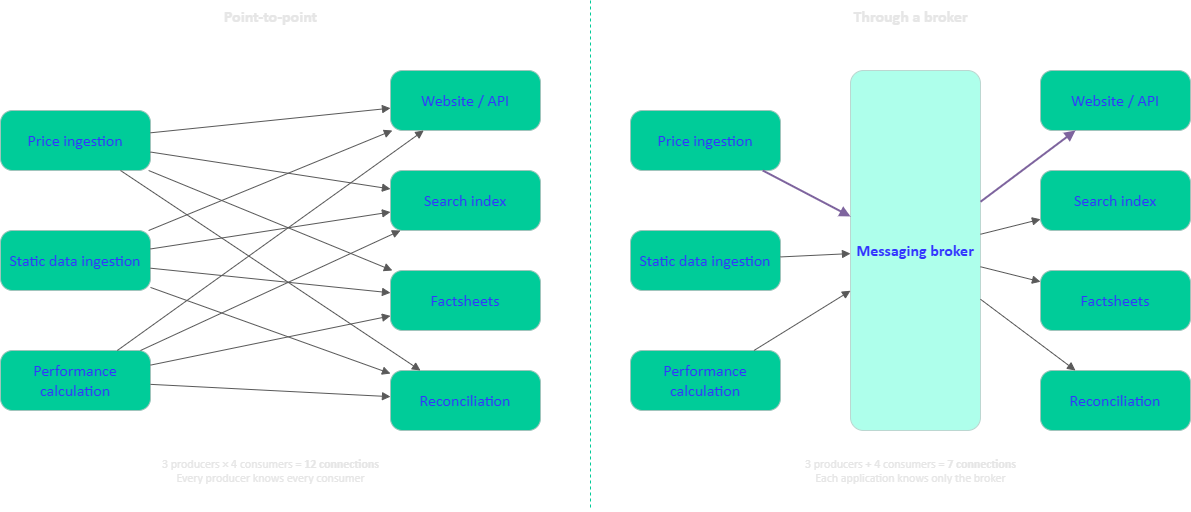
On the left side, every producer calls every consumer directly: 3 × 4 = 12 connections. Each producer knows the address, contract and availability of each consumer, so adding a fifth consumer means changing all three producers, and a slow consumer slows down the producers calling it. The lines are not only network connections; they are release and operational dependencies. With n producers and m consumers, the connections grow as n × m.
On the right side, every application has exactly one connection, to the broker: 3 + 4 = 7 connections, growing as n + m. The flow highlighted in purple is a price change: price ingestion publishes a validated PriceDataPointChanged message to the broker once, and the website/API receives it through its own queue or subscription, as do the other consumers who are interested. A new consumer only subscribes to the broker; the producers don’t change. The producer also doesn’t need to know whether a consumer is available right now, so a slow or offline consumer doesn’t block price ingestion.
The broker is not making all problems disappear. We still need to define a message contract, handle duplicate delivery, monitor backlog and decide what the consumer should do when the data is invalid. The gain is that these concerns are represented at the messaging boundary instead of being repeated as custom code in every caller.
Integration through a broker
A message broker receives messages from producers and makes them available to consumers. Azure Service Bus is one example available in 2018. It provides queues, topics and subscriptions, sessions, duplicate detection, dead-letter queues, scheduled messages, auto-forwarding and peek-lock receive mode.
For the fund platform, a simple flow can look like this,
- A provider adapter receives the daily price file or calls the provider API.
- The adapter validates the envelope and maps the provider fields.
- The platform stores the NAV as a data point.
- The platform publishes a message with ISIN, price date and the changed data point.
- Performance, search, factsheet and reconciliation consumers receive the message independently.
- Each consumer completes, retries or dead-letters its own message.
The broker gives us temporal decoupling. A consumer can be unavailable while messages wait durably. It also gives us location decoupling, because the producer publishes to a channel rather than calling a fixed consumer endpoint. These benefits have a cost: delivery is usually at least once, consumers must be idempotent and the user may see eventual consistency.
Must Do: Define the owner, contract, delivery expectation and failure path for every integration. A queue without an operational owner is only hiding the problem.
Benefits of a well-designed integration
Independent evolution
Consumers can adopt a new message field or new subscription without changing the provider adapter. Producers can publish a stable contract while consumers release on their own schedule. This is not a reason to ignore versioning, but it gives teams room to evolve.
Better resilience
Durable messaging allows work to wait while a consumer is restarting. Retries and dead-letter handling make transient and permanent failures visible. The platform can continue accepting valid provider data even when one downstream calculation is temporarily unavailable.
Reuse of validated data
The mapping and validation stage can create a shared canonical data point. Factsheets, websites and ratings do not need to implement a separate interpretation of every provider’s format. This reduces duplicated transformation logic and improves consistency.
Scale where the work is
If price processing is the hot spot, competing consumers can process the queue in parallel. If factsheet generation is slower, it can use its own subscription and scale independently. We should scale the bottleneck rather than scaling every application together.
Improved operational control
A broker provides a place to measure messages published, received, completed, retried and dead-lettered. Correlation identifiers allow the team to follow one provider file or one price data point across the pipeline. We can move from reactive support calls to proactive detection of a growing backlog.
How should we start?
Do not put every call into a queue only because messaging is fashionable. First classify the interaction,
- Use a synchronous API when the caller needs an immediate answer and the dependency is part of the same user operation.
- Use a file transfer when a provider naturally supplies a batch and the latency is measured in minutes or hours.
- Use a queue when one consumer owns work and it may be processed asynchronously.
- Use a topic and subscriptions when several independent consumers need the same event.
- Use an event notification when consumers need to know that something happened, but do not need the full state in the message.
Start with one meaningful flow, define its failure and replay behaviour, and add monitoring before expanding the pattern. Otherwise, the team will create a distributed system which is harder to diagnose than the original point-to-point design.
Wrap up
In this article, we have looked at what enterprise integration is, why a mutual fund data platform needs it, the common challenges, point-to-point spaghetti and integration through a broker. I really appreciate that you took the time to read this article. In the next article, I will walk you through the five styles of integration: file transfer, shared database, Remote Procedure Call, API-based integration and messaging.
Related Posts
How do messages flow from producer to consumer? - Part 4
How messages flow from producer to consumer: channel adapters, claim check, routers, dispatchers, polling and competing consumers, and ordering.
What are messages, commands and events? - Part 3
Messages, envelopes, commands and events, producers and consumers, channels, queues, topics, brokers and buses, explained with a postal-service model.
What are the styles of integration? - Part 2
The five styles of integration, file transfer, shared database, RPC, API and messaging, with fund-data examples, trade-offs and selection criteria.