Strangler pattern - migrating a legacy monolith step by step
The Strangler pattern provides a staged way to move capabilities from a legacy monolith behind a facade, while preserving contracts, controlling data ownership and reducing migration risk.
Strangler pattern - migrating a legacy monolith step by step
Legacy applications are rarely failing because every line is bad. They are failing because one large deployment is carrying many business capabilities, old dependencies and an increasing amount of risk. A fund platform may contain pricing, units, documents, factsheets and investor access in one monolith, and even a small change is requiring a complete release.
Last year, we discussed Angular 2 versus React and how front-end choices are affecting architecture. We also looked at microservices and their hidden costs. In this article, we are going to see how the Strangler pattern can help us migrate a legacy monolith step by step without attempting a risky rewrite.
TL;DR Summary
- The Strangler pattern places a facade or routing layer in front of a legacy application.
- New capabilities are carved out one by one while the old path continues to serve the remaining functions.
- An anti-corruption layer protects the new model from legacy concepts and data shapes.
- Data ownership must move deliberately; copying data without a consistency plan creates another monolith.
- Feature toggles, observability and rollback are required for safe migration.
- Stop when the remaining legacy capability is small, stable or cheaper to operate than replace.
Challenges
The rewrite trap
A complete rewrite looks clean on a diagram, but it is requiring the team to understand every hidden rule in the old system before delivering value. Fund price rounding, document naming and investor permissions may not be written in one place, and a rewrite is discovering them only after customers are using it.
One release boundary
When pricing and document generation are in one monolith, the team must release both even when only one capability changed. A defect in a new factsheet can block a price fix, and a deployment rollback is affecting unrelated functions.
Data coupling
The old application may allow every module to read every table. Extracting a service without deciding who owns fund facts, units or prices is creating two writers and inconsistent reports.
What is the Strangler pattern?
The Strangler pattern, also called Strangler Fig Application, is a migration approach where a new system gradually replaces parts of a legacy system behind a facade or routing layer.
In simple terms, new functionality is growing around the old application until the old path is no longer needed, similar to a strangler fig growing around a host tree. We are not deleting the monolith on the first day; we are reducing its responsibility in controlled slices.
The following diagram depicts the facade which routes requests to the legacy monolith or an extracted fund capability.
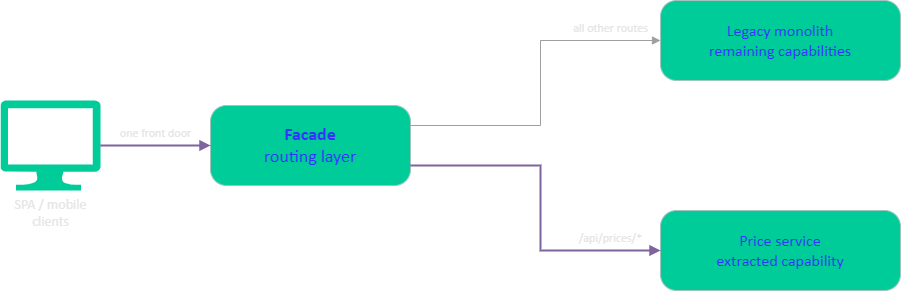
The purple path is a request for the extracted pricing capability. Other requests are still routed to the monolith, and the facade gives clients one stable front door.
Why the Strangler pattern is important?
The pattern is important because it is reducing migration risk and delivering value during the journey. Each extracted capability can have its own deployment, tests and operational ownership, while the remaining monolith is not being changed unnecessarily.
In our case, extracting fund factsheets may be safer than starting with pricing. Factsheets have a clear document boundary, while pricing may be connected to many batch and valuation processes. Choose the first slice from coupling, business value, risk and the team’s ability to observe it.
Migration stages
The following diagram explains the stages from one monolith to a smaller legacy core.
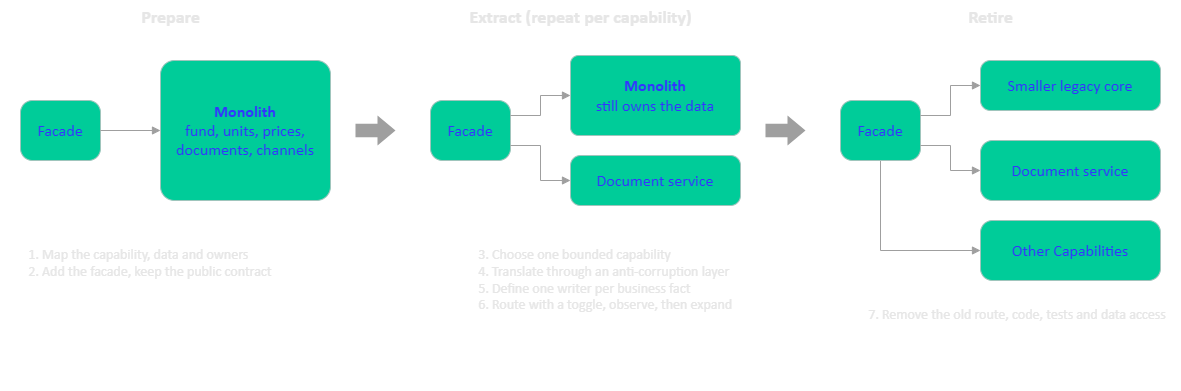
1. Map the current capability
List endpoints, jobs, database tables, external calls and owners. Draw the dependency graph for fund, units, prices, documents and investor channels. Find where the business transaction really ends, not only where a controller method begins.
2. Add the facade
Use a reverse proxy, IIS Application Request Routing (ARR) with URL Rewrite, an API gateway or another routing layer. The 2016 API Gateway article provides a useful front-door comparison. The facade must preserve the public contract while routing canary requests to the new service.
3. Choose one capability
Select a bounded capability such as document generation or fund factsheet retrieval. Keep the first extraction small enough to deploy and roll back, but meaningful enough to remove a real monolith dependency.
4. Add an anti-corruption layer
Legacy names are not always healthy domain names. A legacy FundMaster record may contain pricing, client and reporting fields together. Translate it into a new Fund and FundDocument model at the boundary, so the new service does not copy every legacy assumption.
5. Define data ownership
Choose one writer for each business fact. During transition, the new document service may read a replicated projection while the monolith remains the owner. Later, move the write ownership and publish a change event. Document the acceptable delay and reconciliation process.
6. Route and observe
Use a feature toggle or route rule to send selected traffic to the new capability. Record success rate, latency, errors and business outcomes. Start with internal users or a small fund group, then expand after the pulse check.
7. Remove the old path
After the new capability is stable, remove the old route, code, tests and data access. Source control is preserving history; commented legacy code is not a migration strategy. Continue to monitor clients for calls to the retired path.
Selection criteria and risks
| Decision | Choose the safer path when | Risk to control |
|---|---|---|
| First capability | Boundary is clear and independently testable | Hidden shared rules |
| Routing layer | Clients need one stable endpoint | Facade becomes another monolith |
| Data sync | Legacy remains source of truth temporarily | Stale or duplicate data |
| Feature toggle | Rollout must be gradual | Toggle is never removed |
| Anti-corruption layer | Models have different meanings | Mapping becomes too large |
Feature toggles are useful for migration, but give every toggle an owner and removal condition. Refer the 2016 feature-toggle article for the broader safe-shipping guidance.
When should we stop?
The goal is not always zero legacy code. Stop extracting when the remaining functions are stable, low-risk and cheaper to operate than a new service. Continue when the monolith is blocking independent releases, scaling poorly or carrying a high change cost.
Measure the decision with deployment frequency, incident impact, lead time and the number of clients coupled to the old path. Use placeholders such as <before migration value> and <after migration value> when a real metric is not yet confirmed.
Must Do / Should / Don’t
Must Do
- Must keep one stable facade while routes are changing.
- Must define data ownership and reconciliation before adding a second writer.
- Must add monitoring and rollback before expanding traffic.
- Must remove retired routes and toggles after migration.
Should
- Should start with a capability which has a clear boundary.
- Should use an anti-corruption layer instead of copying legacy models.
- Should migrate in small pull requests and keep the monolith deployable.
Don’t
- Don’t rewrite the complete monolith before learning its hidden business rules.
- Don’t extract a service while leaving two independent writers for the same fact.
- Don’t create a facade which contains business logic for every team.
- Don’t keep old code commented “for safety”; source control is the backup.
Wrap up
In this article, we have looked at the Strangler pattern, facade routing, capability extraction, anti-corruption layers, data ownership, feature toggles, observability and migration stopping criteria.
I really appreciate that you took the time to read this article. In the next article, I will walk you through the Backend for Frontend pattern for SPA and mobile applications.
Related Posts
How to design and implement Future State Architecture? - Part 2
Design a Future State Architecture in three views, logical components, technology choices and solution architecture, and plan the move from the current state.
What is Future State Architecture and why do we need it? - Part 1
A Future State Architecture is a shared destination, not a big-bang rewrite. Learn why we need it, how to think about it in seven steps and the principles behind it.
Architecture Decision Records (ADR) - documenting the "why"
Architecture Decision Records preserve the context behind technical choices, showing how to write, store, review and evolve an ADR through a fund-domain example.