Front-end architecture - Angular 2 vs React for enterprise apps
Angular 2 and React compared for enterprise applications through components, routing, forms, HTTP, state, testing, TypeScript and team architecture decisions.
Front-end architecture - Angular 2 vs React for enterprise apps
A front-end framework affects more than the syntax used to render a page. It defines how teams structure components, manage dependencies, route users, validate forms, call APIs and test the application. In the previous article, we discussed Event Sourcing and choosing an architecture for a real business need. In this article, we are going to compare Angular 2 and React as they are available today, and decide what an enterprise fund application should consider.
TL;DR Summary
- Angular 2 is a framework with an integrated approach to components, dependency injection, routing, forms and HTTP.
- React is a UI library, so the team is choosing more surrounding libraries and conventions.
- Angular 2 final was released in September 2016.
- React 15 and TypeScript 2.0 are relevant choices today.
- Both choices can build a healthy enterprise front end with disciplined boundaries.
- The strongest choice is the one the team can test, hire for, upgrade and support.
- A library list becomes a platform decision when the application grows.
Challenges
The framework decision becomes a team decision
A tool can be technically capable and still be a poor fit if the team cannot support its upgrade path or testing model. Enterprise applications are living for years, so initial developer excitement is not enough evidence. Conventions and ownership must be agreed early.
A library is mistaken for a complete architecture
React provides a component model, but routing, state, HTTP and build choices are selected separately. This flexibility is useful, but it can produce many local decisions. Angular 2 gives more out-of-the-box structure, but its conventions are also becoming a larger commitment.
The application has more than a component tree
Fund search, pricing and documents need error handling, loading state, authentication, caching, accessibility and browser support. Choosing Angular 2 or React does not solve these concerns. The architecture must define how the client is communicating with APIs and keeping business rules out of views.
What is front-end architecture?
A front-end architecture is the set of component, state, routing, data-access, build and testing decisions which shape a browser application.
In simple terms, it is deciding how the fund screen is split into components, how it fetches prices and how another team understands the code six months later. Angular 2 is called as a framework, while React is called as a library.
An everyday analogy is a kitchen. Angular 2 is like a complete kitchen system with cupboards, appliances and a layout. React is like a high-quality cooking surface: we can arrange the rest of the kitchen as we want, but we must choose the cupboards, oven and storage ourselves.
Why front-end architecture is important?
The front end becomes a long-lived product rather than a thin page. A consistent framework can reduce decision load, while a flexible library can allow a team to choose the best pieces. The real cost is measured in maintainability and team learning, not only in the first page rendered.
The following diagram compares the 2016 choices:
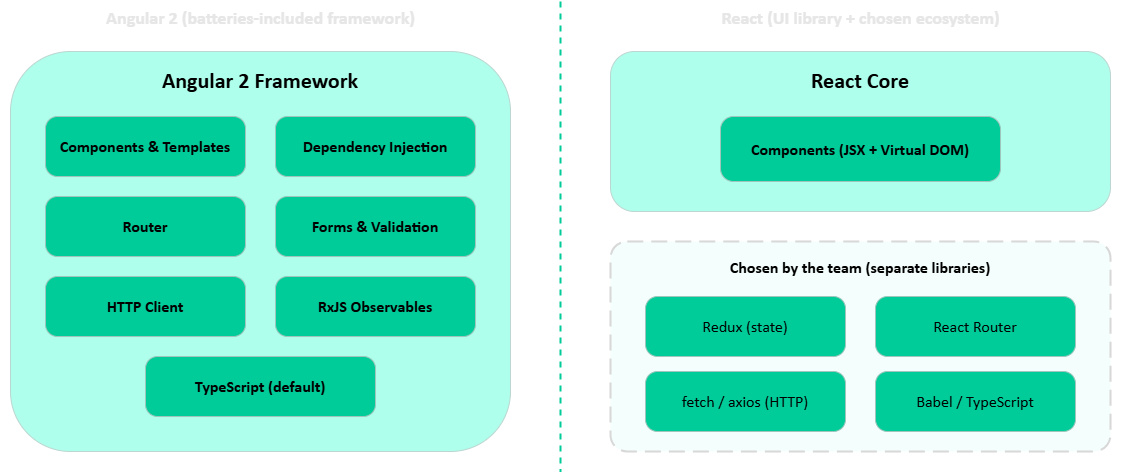
Angular 2 is showing Components, dependency injection, Router, Forms, HTTP, RxJS and TypeScript in one framework boundary. React is showing Components with JSX, while Redux, React Router, fetch or axios, and Babel or TypeScript are separate choices. The diagram is showing responsibility, not declaring one winner.
Angular 2 component example
Angular 2 final was released in September 2016. A fund search component can declare its template and dependency:
import { Component } from '@angular/core';
import { FundService } from './fund.service';

@Component({
  selector: 'fund-search',
  template: `
    <input [(ngModel)]="query" (keyup.enter)="search()" />
    <div *ngFor="let fund of funds">
      {{ fund.name }} - {{ fund.latestPrice }}
    </div>`
})
export class FundSearchComponent {
  query: string;
  funds: FundSummary[] = [];

  constructor(private fundService: FundService) {}

  search() {
    this.fundService.search(this.query)
      .subscribe(result => this.funds = result);
  }
}
Dependency injection is part of the framework model. Forms, routing and HTTP are following Angular conventions. The team is gaining consistency, but the team must learn the framework lifecycle and upgrade path.
React component example
React 15 uses JSX and a component model. The surrounding choices are made by the team:
class FundSearch extends React.Component {
  constructor(props) {
    super(props);
    this.state = { query: '', funds: [] };
  }

  search = () => {
    fetch('/api/funds?query=' + this.state.query)
      .then(response => response.json())
      .then(funds => this.setState({ funds: funds }));
  };

  render() {
    return (
      <div>
        <input value={this.state.query}
               onChange={e => this.setState({ query: e.target.value })}
               onKeyPress={e => e.key === 'Enter' && this.search()} />
        {this.state.funds.map(fund =>
          <div key={fund.id}>{fund.name} - {fund.latestPrice}</div>)}
      </div>
    );
  }
}
This component is working, but production still needs a decision about routing, state management, HTTP errors, build and transpilation. Redux can be used for shared state, React Router for navigation, and Babel or TypeScript for the build. Flexibility is useful only when the team is maintaining one convention.
TypeScript and enterprise concerns
TypeScript 2.0 is released and can be used with both Angular 2 and React. It helps the team describe a FundSummary model and find incorrect property names at build time. It does not replace runtime validation; data arriving from a Web API can still be malformed.
Authentication stays outside individual components. A shared HTTP service or interceptor can attach a bearer token and handle 401 responses. A component should call fundService.search, not store a client secret or implement token renewal in a template.
Comparison
| Concern | Angular 2 (framework) | React (library) |
|---|---|---|
| Components | Integrated component and template model | JSX component model |
| Dependency injection | Built in | Select a library or pass dependencies |
| Routing | Angular Router | Select React Router or another option |
| Forms and HTTP | Framework conventions and modules | Select libraries and conventions |
| State | Services and RxJS patterns | Component state, Redux or another library |
| TypeScript | Natural framework path | Available with build configuration |
| Main trade-off | More integrated structure | More choice and responsibility |
In our case, Angular 2 is suitable when the team wants an integrated framework and is willing to follow its conventions. React is suitable when the team has a clear plan for routing, state, HTTP, build and testing. The decision is based on team capability and application lifetime, not on a short benchmark.
Testing the fund experience
The component test checks behaviour rather than only a snapshot. A fund search test enters FUND-123, mocks the API service and checks that the loading state, result and empty state are displayed. An error response is tested separately because a network failure is part of the user experience.
Angular 2 gives the team dependency injection, so FundService can be replaced by a test double. React allows the component to receive a service or callback through props, while Redux or another store can be tested independently. In both choices, the business rule “do not show a price until the response is valid” is tested without a browser.
Build and browser support are also part of the decision. TypeScript 2.0 code is compiled to the JavaScript target supported by the application browsers. The build checks lint rules, unit tests and bundle output. A route which loads the whole document module when the user only wants Search is reviewed for a lazy-loading or bundle boundary.
The team is documenting the component conventions: file naming, input and output properties, API error shape, accessibility attributes and state ownership. This is reducing the difference between two developers who are building two fund screens. The framework is helping, but the working agreement is completing the architecture.
The comparison is also considering hiring and support. A framework with more integrated choices can make a new team’s first feature predictable, while a library with a broad ecosystem can make specialist hiring easier in some markets. These are not universal facts, so the team is recording its own skills and support plan rather than relying on a survey.
Must Do and Don’ts
- Must Do: Choose and document one routing, state and HTTP convention, otherwise every team will build a different front end.
- Must Do: Keep API access in services and test loading/error states, because components should not own transport details.
- Must Do: Type the shared fund models and validate runtime responses, since TypeScript cannot validate a JSON payload by itself.
- Must Do: Record the 2016 framework and library versions, so a later upgrade is not confused with the original architecture.
- Don’t: select React and postpone every surrounding decision, otherwise flexibility will become inconsistency.
- Don’t: put business rules inside templates, because a pricing rule must be testable without rendering a browser.
Wrap up
In this article, we have looked at Angular 2, React 15, TypeScript 2.0, component code, dependency injection, JSX and the surrounding enterprise decisions. Both choices are capable of serving a fund application when the team is agreeing the complete front-end architecture. I really appreciate that you took the time to read this article and I hope this article provided you some insights into making a front-end decision. This article closes the 2016 Software Architecture series and the 2016 blog year.
Related Posts
Single Page Application (SPA) architecture with AngularJS and Web API
Single Page Application architecture explained through AngularJS routes and services, ASP.NET Web API boundaries, token handling, deep links, validation, and trade-offs.
TypeScript for C# developers - Part 1
TypeScript for C# developers introduces types, interfaces, classes, enums, lambdas, null checks, compilation and familiar concepts from C# development for practical guidance.
Lessons Learned: A Faster SPA with Worse SEO and Ads - Part 3
Lessons from building an AngularJS SPA that improved performance but introduced SEO and advertising problems, including the fixes and trade-offs.