The 'Three Horizons of Cloud Value' — What You're Actually Buying When You Migrate
Why the single-number cloud business case fails — and how to separate operational, architectural, and strategic value into three horizons that can each be funded, measured, and defended on their own timelines.
The ‘Three Horizons of Cloud Value’ — What You’re Actually Buying When You Migrate
Cloud invoices look like one bill. They’re actually three bills, paid on three different timelines, redeemable for three different things.
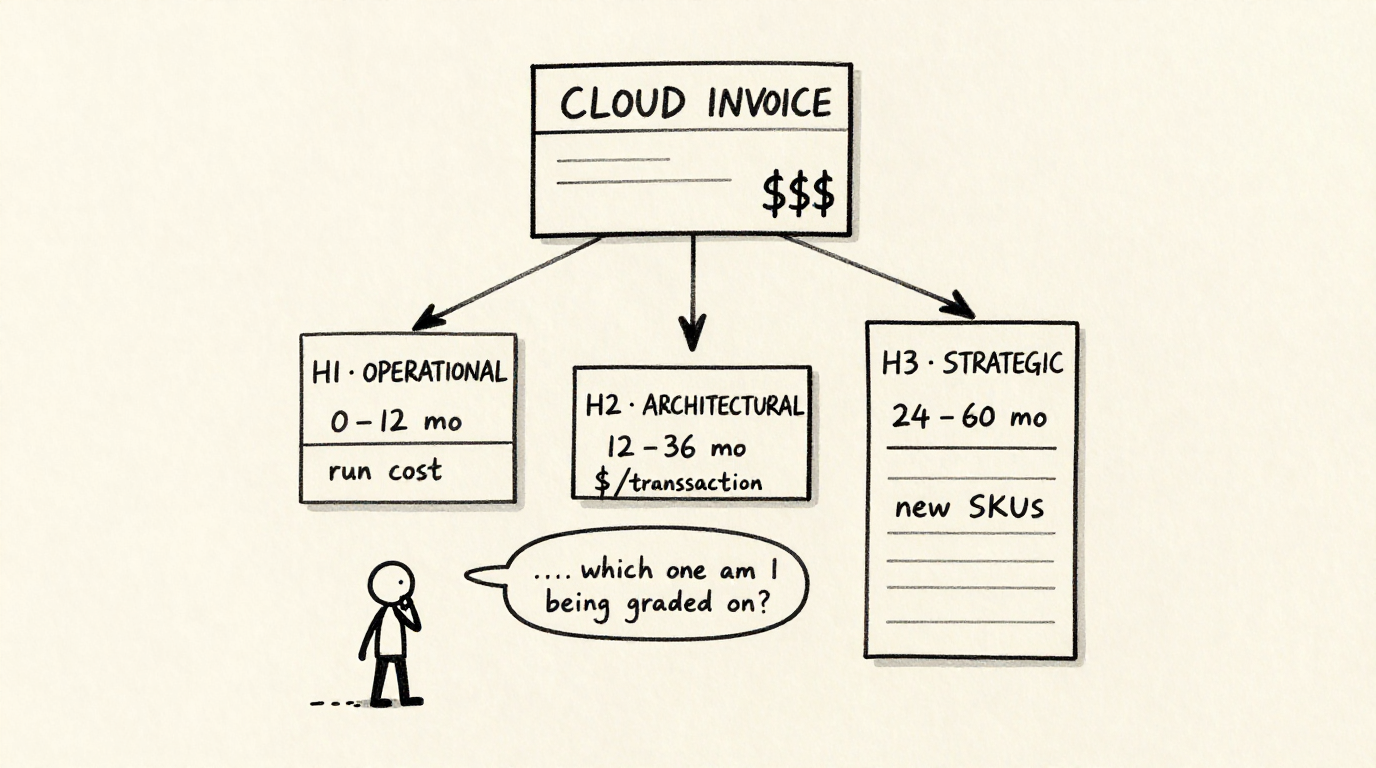
TL;DR: Cloud invoices look like one bill. They’re actually three bills, paid on three different timelines, redeemable for three different things. Through the late-2015s migration wave, most enterprise cloud business cases collapsed value into a single ROI number — and then watched leadership lose faith when Year 1 didn’t deliver Year 3 outcomes. The Three Horizons of Cloud Value framework separates operational savings (H1, 0–12 months), architectural unit-economics wins (H2, 12–36 months), and strategic capability creation (H3, 24–60 months). This piece walks through how to assign every workload to a horizon before you migrate it, how to fund and measure each horizon differently, and how to stop being judged on H3 outcomes against an H1 budget.
The sentence that tanked more cloud programs than any outage
Here’s the line that tanked more late-2015s cloud programs than any technical failure ever did:
“We’re moving to the cloud to save money.”
The line isn’t wrong. It’s under-specified. The cloud will save you money — for some workloads, on some timelines, in some ways. It will also cost you money, sometimes more than the on-prem baseline, and that’s also fine — for some workloads, because you bought something else with the bill. The problem isn’t the math. The problem is that the sentence treats “cloud value” as one thing.
It isn’t. It’s three.
The scene that played out in a thousand boardrooms
You’re sitting in a Q1 2019 cloud-program steering committee. The CFO opens with the slide every CFO opens with: “What’s the projected cloud savings?” The cloud lead, who has been in the role for six months, gives the number from the original business case: “We projected a 22% TCO reduction over three years.”
The CFO nods. Marks the box. Moves on.
Now fast-forward 14 months. It’s March 2020. The same committee. The Azure bill is higher than the on-prem run-cost was. The CFO is unhappy. The cloud lead is on the defensive. “But we shipped the new analytics product, and we cut deploy time from six weeks to two days, and we absorbed last year’s Black Friday surge without buying a single new server.”
The CFO answers, “That’s all great. But where’s my 22%?”
The cloud lead has no good answer — because the 22% projection was an operational estimate, the team actually delivered architectural and strategic value, and there was never a translation layer between the three. The business case promised one thing. The team delivered three different things. The committee was measuring the first thing only.
That conversation, repeated across thousands of organizations through the late-2015s migration wave, is what made the cloud feel like it had over-promised. It hadn’t. The framing had.
The tension nobody named
Look at almost any late-2015s cloud business case and you’ll find numbers from three completely different categories of value mashed into one ROI calculation:
- Operational savings — “We’ll spend 22% less running the same workload.”
- Architectural wins — “We’ll deploy 10× more often and recover from incidents 5× faster.”
- Strategic capabilities — “We’ll launch products we couldn’t have built on-prem.”
Each is real. Each has its own timeline. Each requires a different investment profile. None of them are interchangeable. And yet the typical migration-era business case treated them as if they were all denominated in the same currency, due in the same fiscal year.
That created a specific failure mode.
The team that promised Operational savings on a 12-month timeline was actually doing Architectural work on a 24-month timeline. The team that was secretly building Strategic capability had no permission to talk about it because the program was scoped as a cost-reduction exercise.
By Year 2, the spend had gone up, the cost-savings dashboard was red, and leadership was — entirely reasonably — losing patience with a program that was succeeding in ways nobody had agreed to measure.
The cloud wasn’t the problem. The single-number business case was.
The insight: there are three clouds, and you have to buy them separately
The reframe is simple enough to fit in a sentence and powerful enough to outlast a leadership change:
The cloud doesn’t deliver one kind of value. It delivers three. Until you separate them, you can’t fund them, measure them, or honestly defend them.
That’s the entire framework. Once you say it, every conversation about cloud value gets a layer of honesty it didn’t have before.
The Framework — Three Horizons of Cloud Value
| Horizon | What you’re buying | Timeline | Measurable in | Funded by |
|---|---|---|---|---|
| H1: Operational | Same workload, lower run cost; faster provisioning; reduced datacenter overhead | 0–12 months | $/month, hours-to-provision, % datacenter exit | Run-the-business / opex |
| H2: Architectural | Re-architected workloads; elasticity, resilience, managed services, dev velocity | 12–36 months | $/transaction, MTTR, deploy frequency, scale headroom | Change-the-business / capex blended |
| H3: Strategic | New product capabilities; data, AI, global reach, time-to-market on things that didn’t exist before | 24–60 months | Revenue from new SKUs, market entries, capabilities competitors don’t have | Strategic / R&D / portfolio |
Three horizons. Three timelines. Three different conversations with the CFO. Three different sets of metrics.
H1 — Operational
This is the only horizon where the on-prem TCO comparison makes any sense. You’re moving the same workload. You’re measuring against the same baseline. The right answer is a per-workload, per-month dollar number, and the time-to-value should be measured in months, not years.
H1 is also the horizon most likely to fail to deliver, because it’s where the four hidden cloud taxes live (egress, IOPS metering, license re-baselining, identity rewiring — see the lift-and-shift piece). H1 commitments need to be honest about those taxes upfront or the savings will be eaten by them.
H2 — Architectural
Here the comparison shifts. You’re not measuring against the on-prem baseline anymore — you’re measuring against the same workload, re-imagined. PaaS instead of VMs. Managed databases instead of self-hosted. Stateless services with autoscaling instead of capacity-planned monoliths.
H2 almost always costs more in raw cloud spend than H1. That’s not a failure — it’s a deliberate trade. You’re paying more in compute to buy back engineering time, MTTR reduction, and scale headroom. The right metrics are per-transaction cost, deploy frequency, P99 latency, and time-to-recover. If you measure H2 with H1 metrics, it always loses. If you measure it with H2 metrics, it usually wins by a wide margin.
H3 — Strategic
H3 is the horizon that doesn’t have an on-prem equivalent. There is no baseline to compare against because the thing you’re now doing didn’t exist before. The personalization engine that needs Cosmos DB’s global writes. The market entry that needs a region you don’t have a datacenter in.
The business case for H3 isn’t a TCO calculation. It’s an opportunity-cost calculation. The right question isn’t “did we spend less?” — it’s “would we have shipped this at all without the cloud?” If the answer is no, the cloud paid for itself the moment you signed the customer.
How to actually use this
You don’t roll this out as a transformation program. You roll it out as a label, a budget code, and a review cadence. Three small structural changes:
1. Tag every workload with its horizon at intake. Before any workload enters a migration wave, the program lead assigns it H1, H2, or H3 (or a blend, like H1+H2). The tag is non-negotiable and it appears on every business-case slide, every project ticket, and every cost-management report. Workloads with no tag don’t get migrated.
2. Fund the horizons from different budget pools. H1 comes out of opex, with a 12-month payback expectation. H2 is a blended capex/opex decision tied to a refactor sprint plan and an 18–36-month payback. H3 is portfolio money — same line as new product investment — and it’s not allowed to be judged against H1 metrics. The CFO signs off on three numbers, not one.
3. Run three separate review cadences, not one. H1 reviews are quarterly and look at unit cost. H2 reviews are biannual and look at deploy frequency, MTTR, and per-transaction cost. H3 reviews are annual and look at revenue and market position. The same dashboard cannot serve all three. Trying to make it do so is what created the migration-era mess in the first place.
That’s it. The framework isn’t the value. The value is in forcing the conversation about which horizon a workload belongs to before anyone commits a number to a slide.
When this fits. This framework assumes you’re running a multi-workload cloud program with executive oversight — typically a mid-size or larger enterprise mid-migration. If you’re a single-product team going cloud-native from day one, you’re already living in H2/H3 and the H1 conversation barely applies. If you’re three workloads into a datacenter exit with no strategic ambitions, label it that and skip the rest.
How to measure or confirm
You’ll know whether this framework is working in your org by watching three signals:
- Does any workload in your portfolio have an H3-only label? If every workload in your migration wave is tagged H1, you’re not running a cloud program — you’re running a datacenter exit. That’s fine, but call it that. Real cloud programs have workloads in all three horizons simultaneously.
- Are the metrics on the executive dashboard horizon-specific? If the same dashboard reports unit cost, deploy frequency, and new-product revenue as a single composite “cloud ROI” number, the dashboard is lying. Separate metrics or admit you don’t have them.
- Can a tech lead defend a workload that costs more in the cloud than on-prem? If yes — confidently, with H2 or H3 language — the framework has landed. If the answer is “we’ll optimize the bill next quarter,” you’re back to the migration-era problem.
Common problems
Three failure modes that show up over and over when teams try to use this:
-
Promising H2 outcomes from an H1 budget. This is the most common mistake. The team scopes a workload as H1 (lift-and-shift, cost savings) but quietly delivers H2 (refactored, resilient, faster to deploy). The Year 2 review judges it as H1 and finds it wanting. The fix: lock the horizon in writing at intake, and in the business-case slide. Mid-flight horizon shifts need an explicit re-baselining.
-
Treating the horizons as a roadmap (H1 → H2 → H3). They’re not a roadmap. They’re a portfolio. At any moment, a healthy cloud program has workloads in all three horizons running in parallel. Sequential adoption is what produces the “we’re still on H1 in Year 4” stagnation.
-
Letting H3 hide inside H1 budgets. Strategic initiatives that depend on cloud capability sometimes get smuggled into the migration program because that’s where the funding lives. They then fail to deliver on H1 metrics because they were never H1 work. The fix: H3 work needs its own budget line and its own sponsor, outside the migration program.
Takeaway
Through the late-2015s migration wave, the cloud business case has been a single number. That single number is the problem. It conflated three different bets — on operations, on architecture, and on strategy — into one calculation that none of them could deliver alone, on the same timeline, against the same baseline.
The Three Horizons framework isn’t a complicated idea. It’s just an act of separation. Once you separate the three kinds of value, three kinds of timelines, and three kinds of metrics, the conversation about cloud spend stops being a defensive one and starts being a portfolio one.
If you’re a tech lead presenting cloud value to leadership this year, the most useful question you can ask before the meeting starts is the one nobody asked in the original business case:
“Which of the three are we actually buying — and is anyone on this committee measuring the right one?”
If you can’t answer that question, you’re going to spend the next three years explaining why the bill went up while everything else got better.
If you can, you’re already running a more honest cloud program than 90% of the market.
“The cloud doesn’t deliver one kind of value. It delivers three. Until you separate them, you can’t fund them, measure them, or honestly defend them.”
One bill, three bets — and a steering committee that only knows how to grade one of them.
So before the next review lands on your calendar, sit with the awkward questions:
- Which horizon is your cloud bill actually paying for this quarter — and does the slide deck say the same thing?
- If your CFO opened tomorrow’s meeting with “Where’s my 22%?”, which of the three would you defend first, and would the room accept the answer?
- Are your dashboards measuring what you actually bought, or what someone promised three years ago in a business case nobody has reread since?
If those questions feel uncomfortable, that’s the framework working. If they don’t, you’re probably about to be billed for H1, scoped for H2, and judged on H3 — same as everyone else.
Related Posts
The Cloud Readiness Quadrant — Beyond the Vendor Checklists of 2020
Why the 200-row vendor readiness checklist scores the workload but never the team that runs it at 3 AM — and the four-quadrant frame that fixes it.
The Hidden Cost of "Just Move to Azure" Decisions
The hidden costs of a just-move-to-Azure decision, including dual-running, skills gaps, cloud pricing and ungoverned sprawl.
Cloud Migration as a Socio-Technical Problem (Not Technical)
Why cloud migrations fail through ownership gaps, incentive misalignment and skills shortages, and how to make the operating model part of the migration.