The Cloud Readiness Quadrant — Beyond the Vendor Checklists of 2020
Why the 200-row vendor readiness checklist scores the workload but never the team that runs it at 3 AM — and the four-quadrant frame that fixes it.
The Cloud Readiness Quadrant — Beyond the Vendor Checklists of 2020
Cloud-readiness is not a 200-item Excel sheet. It’s two questions, four quadrants, and one honest conversation.
Every cloud-readiness assessment in 2020 answered the same question: can the workload move? None of them asked the one that actually predicts whether the migration succeeds: can your team run it at 3 AM on Sunday?
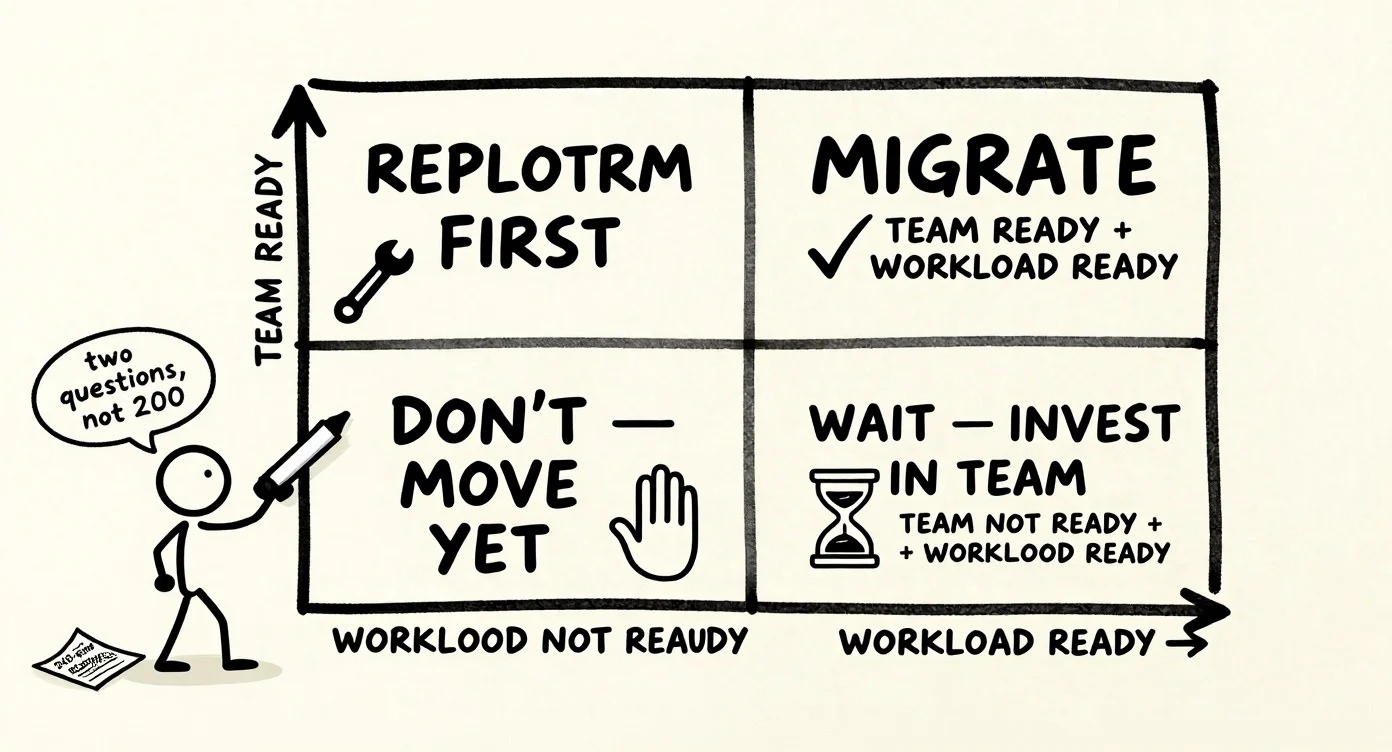
TL;DR: Cloud-readiness assessments in 2020 became a 200-item compliance theatre — vendor checklists that scored the workload and ignored the team that would run it at 3 AM. The Cloud Readiness Quadrant collapses the entire decision into two honest questions: is the workload technically ready, and is the team operationally ready? Two axes, four quadrants, four named actions: Migrate, Replatform first, Wait — invest in team, and Don’t move yet. This piece walks through how the 200-item checklist hides the real risk, why the team axis is the one nobody scores, the four named actions you can take from each quadrant, and what to measure on Day 90 to confirm you got the scoring right.
The question no readiness spreadsheet ever asked
Pull up any cloud-readiness assessment from a 2020 enterprise migration program. You’ll find the same artifact: a Microsoft Excel file, 200+ rows, three colored columns labelled R / A / G, an executive summary that always lands on amber, and a sign-off line at the bottom that nobody really wanted to be the one to refuse.
That spreadsheet has answered exactly one question: can the workload technically run in the cloud?
It has not answered the question that actually predicts whether the migration will succeed: can your team run it there at 3 AM on a Sunday in March, when something breaks in a way the runbook didn’t anticipate?
The first question is a checklist. The second question is the migration.
The scene that played out in a thousand programs
Imagine a Tuesday in February 2020. You’re a senior architect. The cloud-program PMO has scheduled the readiness review for the order-management platform — six services, two databases, one SFTP integration, fifteen years of accumulated cron jobs. The vendor consultants have run their tooling. They produced a 240-row workbook. They’re presenting the results.
The presentation goes for 45 minutes. Slide after slide of green checkboxes: VM-portable, supported OS, supported database engine, network-discoverable, license-portable, no IPv6 dependencies, no hardware HSM, no fax modem (yes, that was an actual row in 2020). At the end, the verdict: “Cloud Ready — Wave 1 candidate.”
You ask one question: “Who is on-call for this in the cloud?”
Silence. Then: “The same team that’s on-call now.”
You ask the follow-up: “What’s their experience with Azure Monitor? With Managed Identity? With network security groups? With the new alerting model?”
More silence. Then, eventually: “They’ll learn.”
That sentence — “they’ll learn” — is where most post-cutover cloud incidents trace back to. The workload was ready. The team wasn’t.
Nobody had a column in the spreadsheet for that, so the row didn’t exist, so the conversation didn’t happen, so the migration shipped.
On the third weekend in production, something broke at 2 AM — and the team that was supposed to run it was reading documentation for the first time, at the worst possible moment.
The 240-row checklist had answered every question except the one that mattered.
The tension nobody priced in
There’s a specific reason the checklists in 2020 measured workloads instead of teams. Workloads are legible. They have version numbers, dependency graphs, port lists. You can scan a workload with a tool and produce a report.
Teams are illegible. There’s no scanner that returns a number for “on-call maturity” or “incident postmortem culture” or “ability to debug a managed service the team has never seen before.” Every honest measure of team readiness is a judgment call, and judgment calls don’t survive a vendor consulting engagement.
So the assessment industrialized around the half it could measure. The other half — the part that determines whether the migration actually works — got dropped. Not maliciously. Just invisibly, because invisible work doesn’t make it onto a colored spreadsheet.
The result: every 2020 cloud-readiness sign-off was an answer to a question nobody had asked. The question was “can it move?” The answer the business actually needed was “can we run it once it’s there?” These are not the same question, and treating them as the same is what produces the post-cutover incident tail every migration wave eventually owns up to.
The insight: cloud-readiness is two questions, not 200
Here’s the reframe.
Cloud-readiness has never been a property of the workload. It has always been a property of the pair: the workload, and the team that will operate it. Until you score both, you haven’t assessed readiness — you’ve assessed moveability. Different word. Different question. Different outcome.
Once you accept that framing, the entire 240-row spreadsheet collapses to two questions.
The Framework — The Cloud Readiness Quadrant
Two axes. Four quadrants. Four named actions. If it can’t be drawn in 60 seconds on a whiteboard, it isn’t a framework. This one can.
| Workload Ready | Workload Not Ready | |
|---|---|---|
| Team Ready | Migrate | Replatform first |
| Team Not Ready | Wait — invest in team | Don’t move yet |
The two axes
-
Workload axis — can it run? Is the system technically able to operate on the target cloud? Stateless or state-managed cleanly. Observable (logs, metrics, traces emitted in formats the cloud’s tools can ingest). Automatable (can be deployed without a human pressing a button on a dashboard). License-portable. No hardware affinities. No silent assumptions about the local network.
-
Team axis — can they run it? Is the operating team able to keep it healthy once it’s there? On-call rotation that’s actually staffed, not aspirational. Runbook-driven, not folklore-driven. Comfortable with infrastructure-as-code. Postmortem culture that produces actions, not blame. Familiar with the specific cloud’s identity model, networking model, and managed-service quirks.
The four quadrants
-
Migrate (both axes green) — Both the workload and the team are ready. Ship the migration on schedule. Schedule the post-migration optimization sprint at the same time you schedule the cutover.
-
Replatform first (team ready, workload not) — The people are ready; the system isn’t. Refactor before you migrate. If you skip this and lift-and-shift, you don’t get a cloud-native system later — you get a capable team running a brittle workload on someone else’s infrastructure, which is the worst of both worlds.
-
Wait — invest in team (workload ready, team not) — The system can move; the people can’t yet operate it. This is the most dangerous quadrant in 2020 because it looks like the Migrate quadrant on every workload-only checklist. The fix isn’t to delay the migration program — it’s to invest in team readiness as a parallel workstream, with budget, training, and shadow on-call rotations on a smaller cloud workload first.
-
Don’t move yet (both axes red) — Stop the steering committee. There is no version of this migration that succeeds. Either the workload moves into a more brittle state or the team takes incidents they can’t resolve. Either path produces a postmortem you’ll be reading at the next board meeting. Pick one axis and invest until it flips green, then re-assess.
How to apply this without a transformation program
You don’t need a new tool or a new methodology. You need a single 60-minute meeting per workload, scheduled before the spreadsheet starts.
1. Score every workload on both axes — before the 240-row checklist runs. A two-axis score is a 60-minute conversation between the architect, the engineering lead, and the operations manager. It produces a single quadrant assignment and a one-paragraph rationale. If the spreadsheet later disagrees, the spreadsheet loses — because the spreadsheet only sees one axis.
2. Score the operating team, not the migration team. This is the single biggest scoring mistake. The migration team is, by definition, cloud-fluent — they’re being paid to be. The team that inherits the workload after cutover is usually a different team, often less experienced with the cloud, almost always less protected by sponsor attention. The team-axis score belongs to whoever is on-call on Day 90, not Day 0.
3. Re-score quarterly. Both axes shift. Workloads get refactored. Teams hire, learn, and lose people. A workload in Wait — invest in team in Q1 should be in Migrate by Q3 if the team-readiness investment is real. If a workload sits in the same quadrant for three quarters in a row, something is wrong with the program, not the assessment.
That’s the entire rollout. Two axes, four quadrants, one 60-minute meeting per workload, re-scored quarterly. No vendor required.
When this fits. This framework assumes a meaningful gap between the team that ships a workload and the team that runs it — typically a mid-size or larger enterprise where migration squads and operating squads are distinct. If a single small team owns build and run for every workload, both axes collapse and the quadrant becomes overkill; the workload-only checklist is enough. If your operating team is already cloud-fluent across the entire portfolio, the team axis isn’t the bottleneck — keep the quadrant on the wall as a re-score discipline, not a gating mechanism.
How to measure or confirm
The framework is working when you can see four signals:
- Some workloads are explicitly in the Wait quadrant — and the program respects them. If every workload is in Migrate, the framework hasn’t landed; the team-axis score is being inflated to keep the program on schedule. A healthy 2020 cloud portfolio has 15–30% of workloads parked in the lower-left quadrants at any given time.
- Cloud incidents in the first 90 days post-cutover correlate with Day-0 quadrant assignment. Workloads that were honestly scored as Migrate should produce few “we didn’t know how to operate this” tickets. Workloads scored as Wait but migrated anyway should produce many. If you don’t see that correlation, the scoring was performative.
- The “team-readiness investment” line item exists in the program budget. If team readiness is everyone’s responsibility, it’s nobody’s budget. A real Wait-quadrant program funds shadow rotations, training tracks, and a smaller pilot workload to build muscle memory.
- The quadrant assignment appears on the migration approval slide. Not the 240-row spreadsheet — the quadrant. If leadership signs off on Migrate without seeing the quadrant designation, the framework hasn’t reached the decision-making layer.
Common problems
Three failure modes to watch for when teams try to use this:
-
Scoring the migration team, not the operations team. The most common scoring error. Fix: name the on-call rotation that will exist 90 days after cutover. Score that rotation. If you can’t name it, you have an org problem, not a cloud problem.
-
“We already have a 200-item assessment, we don’t need a quadrant.” The 200-item assessment and the quadrant answer different questions. The quadrant doesn’t replace the spreadsheet — it frames what the spreadsheet means. Run both. The spreadsheet validates the workload axis; the quadrant adds the team axis.
-
Treating the quadrant as a one-time gate. It isn’t. A workload in Migrate today can drift to Wait — invest in team by next quarter if the operating team loses its senior cloud engineer. A workload in Don’t move yet can flip to Migrate in two quarters if the team invests. Quadrant assignments are current state, not permanent labels.
Takeaway
The 2020 cloud-readiness checklist was an honest tool used dishonestly. Honest, because the checks it ran were real. Dishonest, because it was treated as a complete answer when it was only ever half of one.
The Cloud Readiness Quadrant doesn’t replace the checklist. It completes it. The checklist scores the workload; the quadrant scores the workload and the team that will run it. The quadrant is what tells you which of the four actions is actually safe to take this quarter.
If you’re a tech lead in the middle of a 2020 migration wave, the most useful question you can ask in the next steering committee isn’t “is this workload cloud-ready?” It’s:
“Which quadrant is this workload in right now, and who’s the named owner of moving it to Migrate before we cut over?”
If nobody has an answer, you’re not running a migration. You’re running an experiment with the on-call team’s weekend as the test bed.
If somebody does, you’re running the only kind of cloud program that works in 2020 — the kind that admits, in writing, that the workload was never the hard part.
“Cloud-readiness was never a workload property. It’s a pair of properties — the workload and the people who’ll run it at 3 AM.”
Two axes, four quadrants — and a column the 240-row spreadsheet never had room for.
So before the next sign-off slide goes up, ask yourself the question the checklist didn’t:
If the team that picks up the pager on Day 31 isn’t the team that signed the readiness sheet on Day 0, what exactly did anyone sign off on?
Related Posts
The Myth of "Cloud Readiness" in Enterprise Systems
Why running an application on a virtual machine is not cloud readiness, and which architecture and operating capabilities to assess.
The 'Three Horizons of Cloud Value' — What You're Actually Buying When You Migrate
Why the single-number cloud business case fails — and how to separate operational, architectural, and strategic value into three horizons that can each be funded, measured, and defended on their own timelines.
Cloud Migration as a Socio-Technical Problem (Not Technical)
Why cloud migrations fail through ownership gaps, incentive misalignment and skills shortages, and how to make the operating model part of the migration.