What I Wish I Knew When I Was 10 Years in Tech
Two decades of lessons. Five problems nobody warned me about. The invisible struggles most developer faces—and how to navigate them.
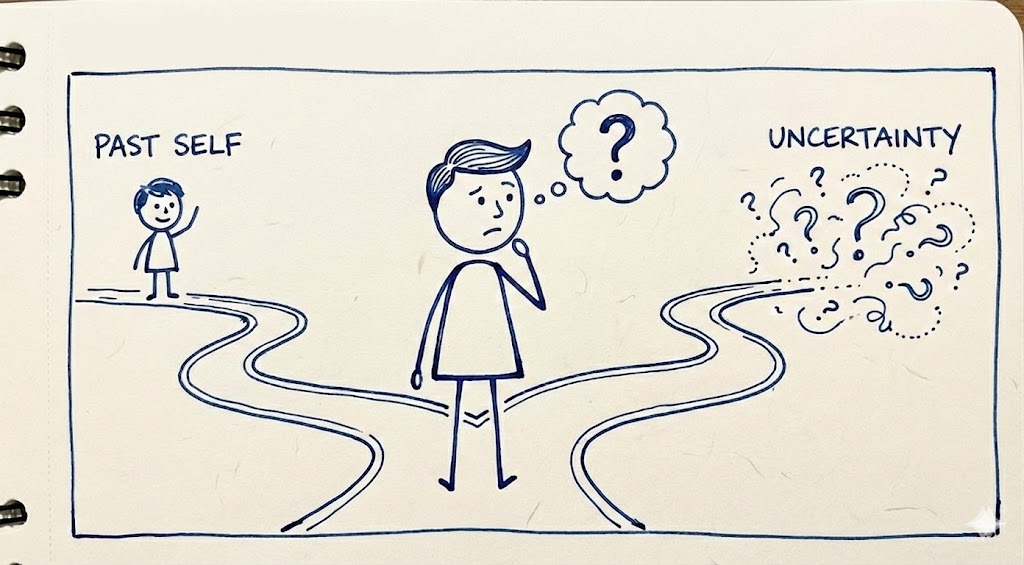
What I Wish I Knew When I Was 10 Years in Tech
Two decades in. Looking back at my 10-year mark, I thought I had it figured out. I was wrong about almost everything that mattered.
At 10 years, I was technically strong. I could architect systems, debug complex problems, ship features that moved with decent metrics. But the skills I obsessed over mattered far less than I thought. The soft skills I dismissed as “not real engineering” turned out to be everything.
Now, with another decade of perspective, here’s what nobody told me back then: the hardest problems in software development aren’t technical. They’re the invisible struggles that every developer faces—the ones we rarely talk about openly.
The 5 Essential Problems Every Developer Faces
After two decades of building software, mentoring engineers, and making every mistake possible, I’ve identified five core problems that define the developer experience. These aren’t bugs or system design challenges. They’re deeper—touching technology, human behavior, and the complex intersection of both.
Problem 1: The Stagnation Spiral
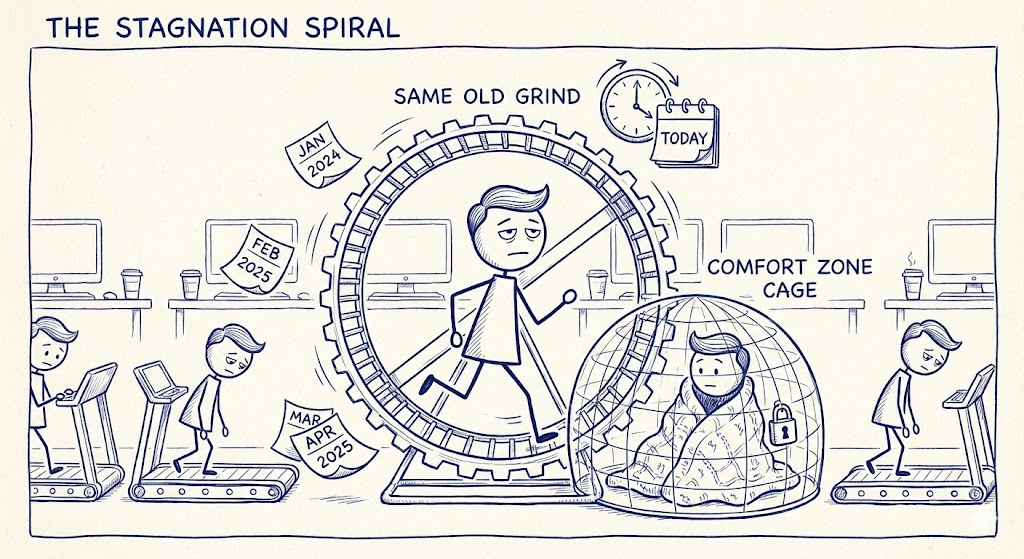
The Pain: You’ve stopped learning. You do the same work, solve the same problems, use the same patterns. Years pass, but your skills stay frozen. You’re comfortable—and that comfort is slowly making you obsolete.
What’s Really Happening: Most developers plateau without realizing it. They master enough to be functional, then coast. The job doesn’t demand more, so they don’t give more. Five years of experience becomes one year repeated five times.
The Socio-Technical Reality: The industry is filled with average developers surrounded by other average developers. When mediocrity is the norm, there’s no pressure to improve. You never feel outclassed because you’ve never been in a room that would outclass you. You mistake comfort for competence.
The Pattern Most Developers Live:
- You learn just enough to do your job
- You avoid projects that would expose your gaps
- You stick to familiar technologies because new ones feel risky
- You compare yourself to peers at the same level, never to the best
- You stop reading, stop building side projects, stop being curious
- You tell yourself you’re “experienced” when you’re actually just “unchanged”
Why This Is Dangerous: The tech industry doesn’t stand still. The developer who was “good enough” in 2015 with jQuery is struggling in 2025 with modern frameworks. The comfort that felt safe becomes a cage. By the time you realize you’ve fallen behind, catching up feels impossible.
What Actually Helps:
- Seek environments that challenge you, not ones that confirm you
- Work with people better than you—it’s uncomfortable, but it’s how you grow
- Take on projects that scare you slightly
- Set learning goals that have nothing to do with your current job
- Ask yourself: “Am I growing, or just aging in this role?”
The Mindset Shift: Comfort is the enemy of growth. The developers who thrive long-term are the ones who stay uncomfortable on purpose. They seek out the rooms where they feel outclassed. They choose the projects that expose their gaps. They treat discomfort as data, not danger.
The real question isn’t “Am I good enough?” It’s “Am I still getting better?”
Problem 2: The Technology Treadmill
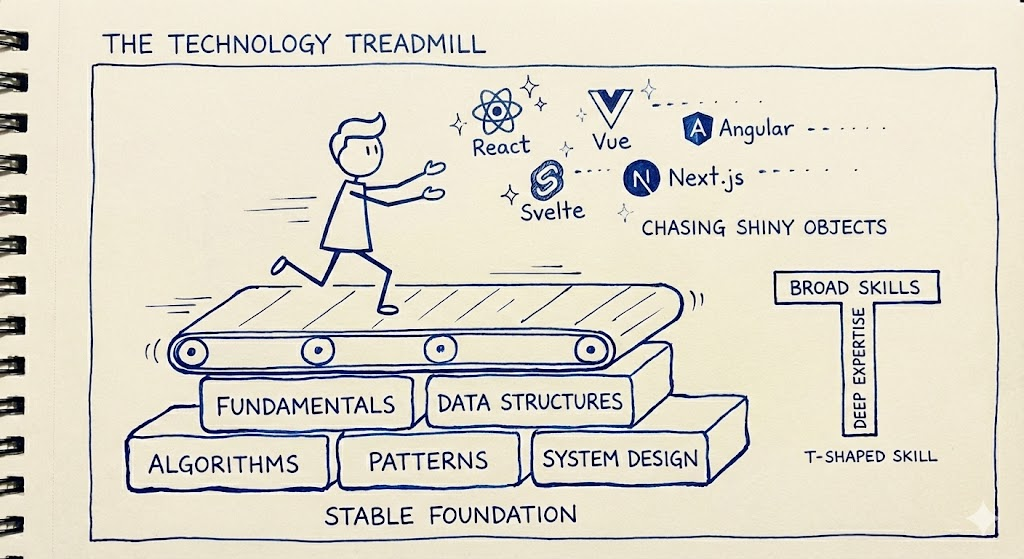
But here’s the twist: some developers overcorrect. They escape stagnation by chasing every new thing—and fall into a different trap.
The Pain: Every week brings a new framework, a new paradigm, a new “right way” to build software. You master React, then everyone’s talking about Svelte. You learn REST, then GraphQL becomes essential. You feel perpetually behind.
What’s Really Happening: The industry conflates novelty with progress. Not every new tool is better—many are just different. But the fear of becoming obsolete drives constant chasing.
The Technological Reality: Most “revolutionary” technologies solve the same fundamental problems in slightly different ways. The core concepts—state management, data flow, abstraction, composition—remain stable across decades.
What Fades:
- Specific framework knowledge (remember Backbone? Knockout? Angular 1?)
- Language syntax details
- Tool-specific workflows
- “Best practices” that change every two years
What Compounds:
- Problem decomposition
- Reading and understanding unfamiliar code
- Debugging mindset and systematic troubleshooting
- System design intuition
- Understanding trade-offs, not just solutions
What Actually Helps:
- Learn one thing deeply before chasing the next shiny object
- Focus on fundamentals: data structures, algorithms, system design patterns
- Ask “what problem does this solve?” before adopting new technology
- Accept that you can’t know everything—and that’s okay
- Build a T-shaped skill set: broad awareness, deep expertise in one area
The Mindset Shift: You’re not falling behind. You’re being selective. The engineers who thrive long-term aren’t the ones who know every framework—they’re the ones who can learn any framework quickly because they understand the underlying principles.
The frameworks I mastered in 2015 are largely irrelevant today. The debugging mindset, the ability to read code, the intuition for system design—those compound. Technical skills have a half-life. Fundamentals don’t.
Problem 3: The Communication Chasm
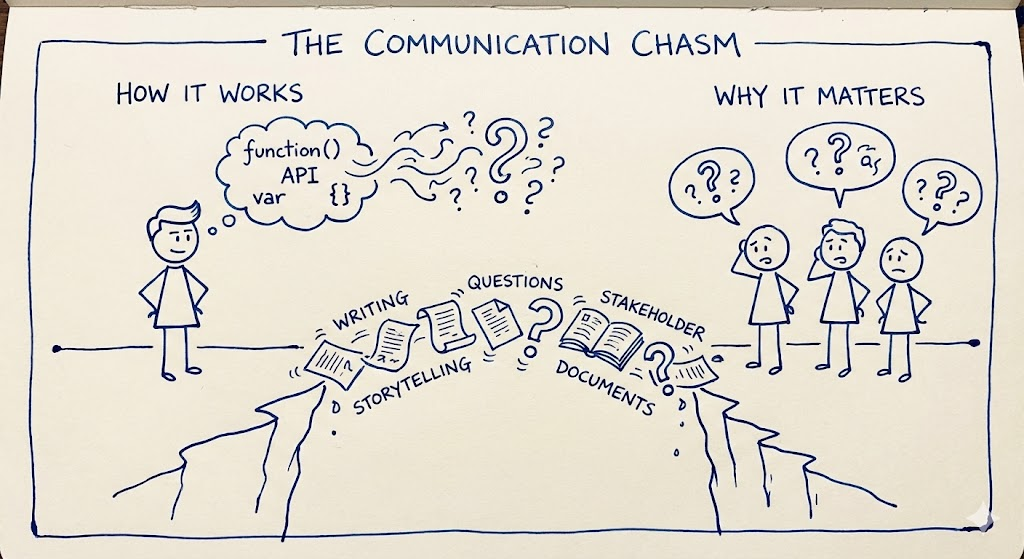
Mastering fundamentals and staying current is only half the battle. The other half? Getting others to understand what you’ve built—and why it matters.
The Pain: You build something technically excellent. Nobody understands why it matters. Your proposals get rejected. Your ideas get ignored. You feel invisible despite doing great work.
What’s Really Happening: Technical skill and communication skill are independent axes. Many brilliant engineers struggle to translate their expertise into language that resonates with non-technical stakeholders—or even other engineers in different domains.
The Socio-Technical Reality: Code is the easy part. Convincing a product manager that technical debt matters, explaining to executives why a “simple” feature takes months, aligning a team on architecture decisions—these require a completely different skill set.
The Behavioral Pattern:
- You assume others see what you see
- You use jargon that creates distance instead of clarity
- You focus on how something works instead of why it matters
- You mistake silence for agreement
What Actually Helps:
- Write more. Design documents, RFCs, incident reports, emails. Writing is thinking made visible. The ability to write clearly has opened more doors than any technical skill I’ve developed.
- Learn to tell stories. “We need to refactor the authentication module” lands differently than “Users are waiting 8 seconds to log in, and we’re losing 12% of them. Here’s how we fix it.”
- Practice explaining technical concepts to non-technical people. If you can’t explain it simply, you don’t understand it well enough.
- Ask questions relentlessly. The fear of looking stupid kept me from asking questions that would have saved weeks of work. The best engineers I know ask more questions, not fewer.
The Mindset Shift: Communication isn’t a “soft skill” that’s nice to have. It’s the skill that determines whether your technical skills matter at all.
Problem 4: The Conflict Avoidance Trap
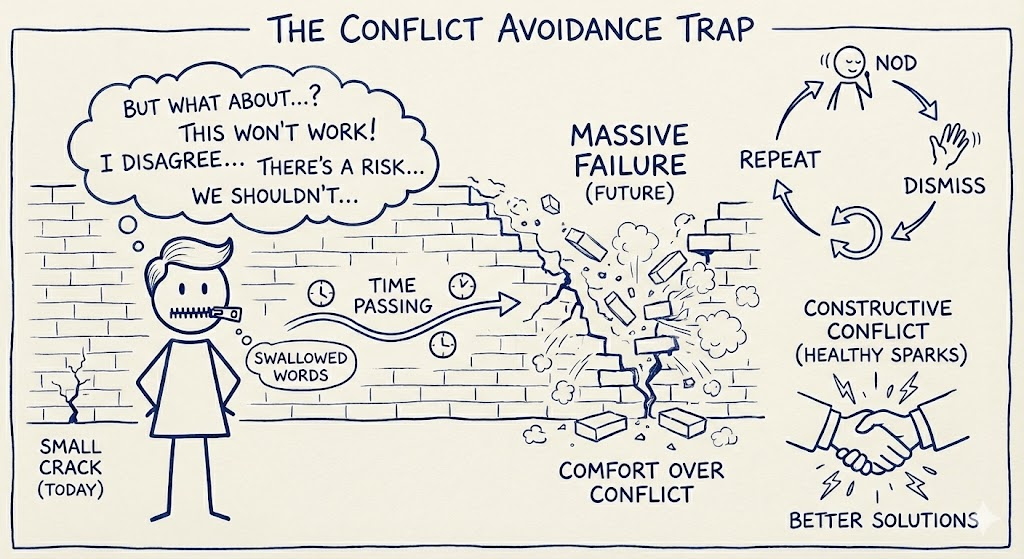
Communication gets you heard. But what happens when you disagree? Most developers go silent—and that silence has a cost.
The Pain: You disagree with a technical decision but stay silent. You see problems but don’t raise them. You let suboptimal solutions ship because confrontation feels uncomfortable.
What’s Really Happening: Most developers are conflict-averse. We chose a career where we interact with machines more than people. Disagreement feels risky—what if we’re wrong? What if we damage relationships?
The Behavioral Reality: Avoiding conflict doesn’t prevent it. It delays it while adding compound interest. The technical debt you didn’t push back on becomes a crisis. The architecture decision you silently disagreed with becomes a rewrite. The feedback you didn’t give becomes a performance issue.
The Pattern I Lived:
- Leadership gives feedback → I nod politely
- I internally dismiss it as “not understanding the full picture”
- Nothing changes
- Same feedback resurfaces months later
- I feel frustrated that they “keep bringing this up”
I let technical disagreements fester instead of addressing them directly. The short-term discomfort of conflict is nothing compared to the long-term cost of unresolved tension.
What Actually Helps:
- Start small. Disagree about lunch choices. Push back on meeting times. Build the muscle in low-stakes situations.
- Separate the idea from the person. “I see this differently” isn’t an attack on someone’s competence.
- Use questions instead of statements. “Have we considered the scaling implications?” lands softer than “This won’t scale.”
- Follow up. After difficult conversations, circle back. Show that disagreement didn’t damage the relationship.
The Mindset Shift: Healthy conflict is a feature, not a bug. Teams that can disagree productively build better software than teams where everyone stays silent.
Problem 5: The Burnout Blindspot
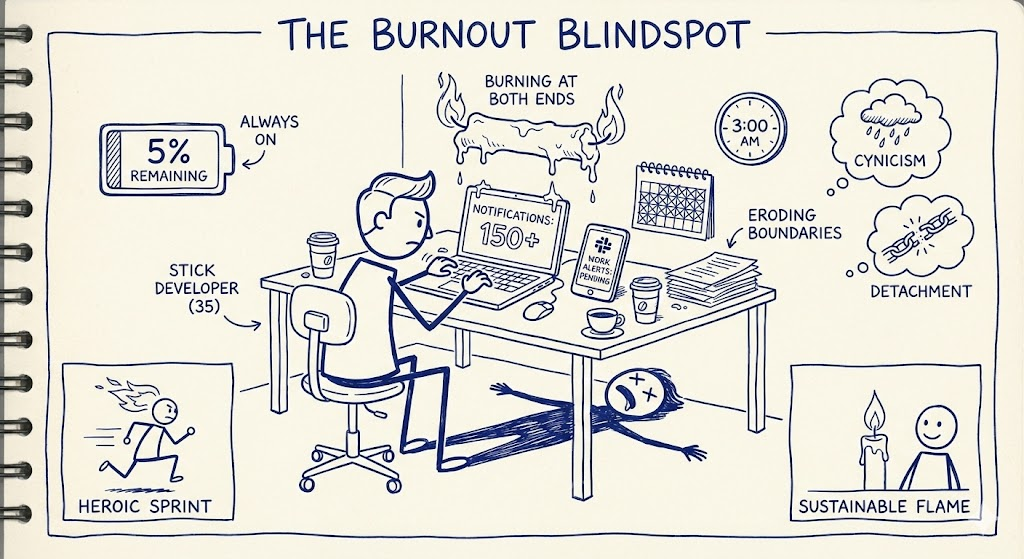
Growth, learning, communication, productive conflict—all of this takes energy. And energy is finite. The final problem is the one that undermines everything else.
The Pain: You’re exhausted but can’t stop. You feel guilty taking breaks. You measure your worth by your output. You’ve forgotten what you enjoy outside of work.
What’s Really Happening: Tech culture glorifies overwork. “Hustle” is celebrated. Taking time off feels like falling behind. The always-on nature of modern development—Slack notifications, on-call rotations, “quick fixes” at midnight—erodes boundaries until there are none.
The Socio-Technical Reality: The tools that make us productive also make us perpetually available. The same laptop that lets you work from anywhere means you can work from everywhere. The line between “connected” and “consumed” disappears.
The Behavioral Pattern:
- You work late to prove dedication
- You skip vacations because “there’s too much to do”
- You check Slack on weekends “just in case”
- You define yourself by your job title
- You feel anxious when you’re not being “productive”
What Actually Helps:
- Recognize that rest is productive. Your best ideas don’t come from hour 12 of staring at code. They come from walks, showers, sleep—moments when your brain processes in the background.
- Set boundaries and defend them. “I don’t check Slack after 7pm” isn’t laziness. It’s sustainability.
- Cultivate identity outside work. Hobbies, relationships, interests that have nothing to do with code. When work is your only source of meaning, any setback becomes existential.
- Watch for the warning signs. Cynicism, detachment, decreased effectiveness, physical symptoms. Burnout doesn’t announce itself—it accumulates.
The Mindset Shift: Sustainable pace beats heroic sprints. The engineers who have long, impactful careers aren’t the ones who burned brightest—they’re the ones who learned to burn steadily.
The Uncomfortable Truth
The next decade will bring changes I can’t predict. AI is already transforming how we write code. New paradigms will emerge. Some of what I’ve learned will become obsolete.
But I’m confident the fundamentals will remain valuable:
- Clear thinking
- Effective communication
- Genuine curiosity
- The courage to engage with hard problems—technical and human
The developers who build lasting, impactful careers won’t be the ones who know the most today. They’ll be the ones who learn the fastest, communicate the clearest, and have the courage to face the problems everyone else avoids.
What problem are you avoiding right now? That’s probably the one most worth solving.
Related Posts
The Conversation I Avoided for Years
What conflict avoidance really costs. How dodging critical feedback slowly eroded my credibility, trust, and career opportunities—and what finally changed.
Cloud Migration as a Socio-Technical Problem (Not Technical)
Why cloud migrations fail through ownership gaps, incentive misalignment and skills shortages, and how to make the operating model part of the migration.
DevOps Without Culture: The Silent Failure
Why DevOps tooling without shared ownership, blameless response and short feedback loops automates a broken process.