Plan Mindfully, Execute Mindlessly — The New Software Engineering Mantra
Why AI inverts the planning-to-execution ratio in software engineering, and a 6-step framework for shipping with AI without producing expensive rework.
Plan Mindfully, Execute Mindlessly — The New Software Engineering Mantra
AI made execution nearly free. Planning quality is now the bottleneck — and the engineers who realize it are pulling ahead.
The highest-paid skill in the AI era is thinking before doing. Plan like every minute of planning saves an hour of execution — because now it actually does.
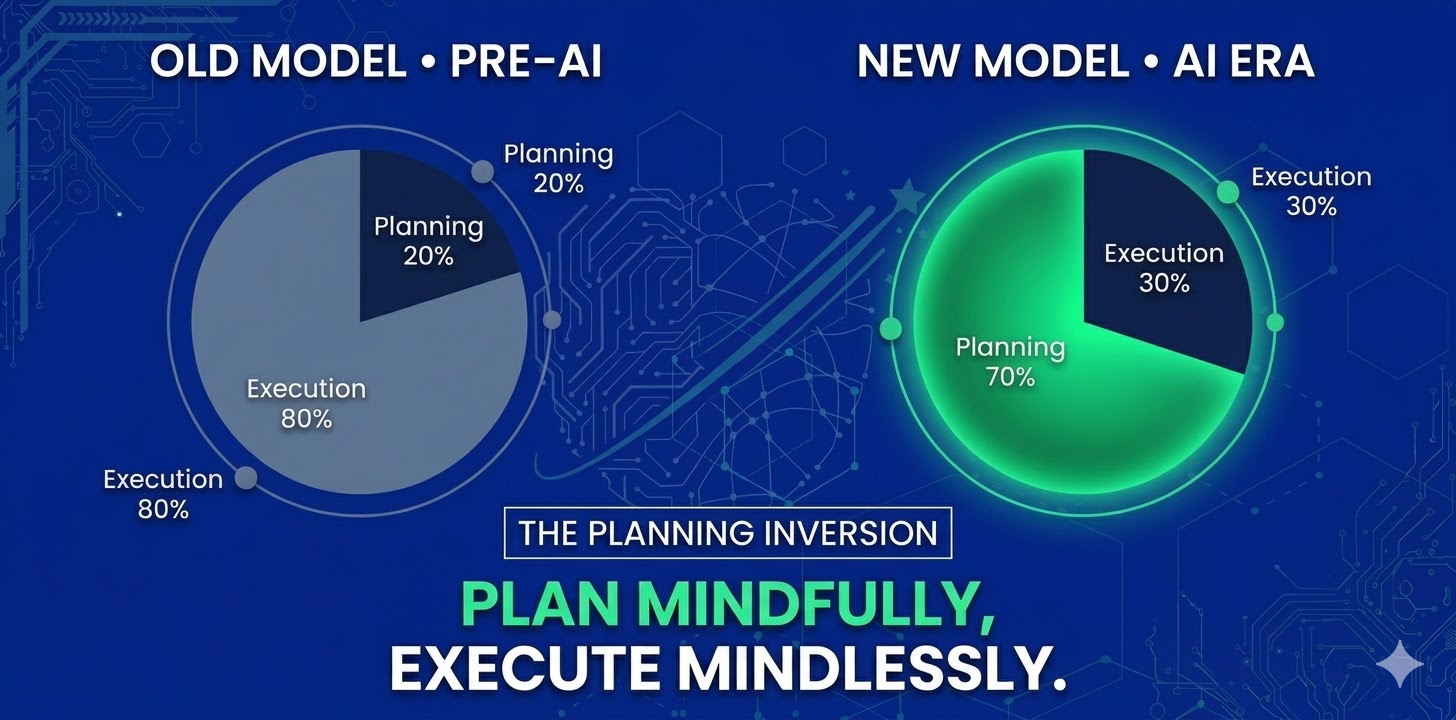
AI writes code faster than any of us ever could. That’s not the problem. The problem is that most teams are feeding it vague inputs and spending hours fixing the output. The fastest path to shipping isn’t prompting faster — it’s planning better before the first prompt.
Why This Matters Now
For past couple of decades, the engineering playbook was simple: plan a little, execute a lot. Sprint planning was a few minutes to few hours ceremony. The real work was grinding through Azure DevOps / Jira tickets, line by line, commit by commit. Execution speed was the differentiator. The fastest coder won.
That model is dying — fast.
AI is flipping the leverage point. As execution becomes nearly free — as AI generates working implementations in seconds/minutes — the bottleneck is shifting to the quality of the instructions we give it.
The old ratio: 20% planning, 80% execution. Execution speed = competitive advantage. Where it’s heading: 70% planning, 30% execution. Planning quality = competitive advantage.
The engineers who are internalizing this shift are already outperforming everyone else. The ones who don’t are becoming fast at producing rework.
The Planning-Execution Inversion — Happening Now
Think of it like this:
Old model: A chef who spends 5 minutes reading a recipe and 2 hours cooking. Skill = cooking speed.
New model: A chef who spends few minutes to an hour designing the menu, selecting ingredients, and writing precise instructions — then hands them to a team of sous chefs who execute in 15 minutes. Skill = menu design and instruction clarity.
The sous chefs (AI) are fast and capable. But they do exactly what we tell them. If our instructions are vague, they’ll produce vague output. If our instructions have gaps, they’ll fill the gaps with assumptions, without asking any clarifications. If our instructions are contradictory, they’ll pick one interpretation without telling us.
The quality of the output is bounded by the quality of the plan.
This is the fundamental insight. Everything else follows from it.
The Cost of Skipping Planning
Let’s be specific about what happens when teams jump straight to prompting:
Scenario: No Plan
Engineer: “Hey AI, build me a user authentication system.”
AI generates a working auth system — but it chooses JWT bearer tokens (maybe we wanted cookie-based ASP.NET Identity sessions), uses BCrypt (maybe our org requires Argon2), creates a new Users table (maybe we already have one), and ignores our MFA requirements, middleware pipeline, and ProblemDetails error conventions.
Result: 3-5 hours of rework. The first 10 minutes feel incredibly fast. The next 3 hours of rework tell the real story. Somewhere around hour two, patience runs out. You stop carefully evaluating AI’s output and start accepting whatever it gives you — just to be done. That’s when you lose control. And what follows is predictable: some engineers keep patching — tweaking, re-prompting, shipping code they’re not confident in. Others abandon AI entirely out of frustration, falling back to writing it manually, thinking “I could have done this faster myself.” Both paths are a loss. Neither would have happened if the plan had been right from the start.
Scenario: Partial Plan
Most engineers don’t give AI zero context. They give it some — and that’s where the false sense of security lives.
Engineer: “Build a user auth system using ASP.NET Identity with cookie auth. We use EF Core and SQL Server. Follow clean architecture.”
AI generates a reasonable implementation matching the broad strokes. It picks sensible defaults for everything not specified. But it doesn’t know about the existing IUserRepository abstraction, MFA requirements for admins via Azure AD B2C, or our RFC 7807 ProblemDetails convention. The code looks right. It even runs. But it doesn’t fit the system.
Result: 1-2 hours of rework. Less obvious than the zero-plan scenario because the output is close enough to seem finished. The dangerous part: it often passes a casual review and the gaps surface later in integration or production.
This is the scenario I’ve lived through more times than I’d like to admit. The partial plan feels responsible — you did give context, you did specify constraints. But “some context” creates a false sense of completeness. The gaps aren’t visible until integration or production, and by then, the cost of fixing them has multiplied. In my experience, the partial plan is where most teams live — and where the most invisible waste accumulates.
Scenario: With Plan
Engineer provides: authentication method (ASP.NET Identity + cookie auth + Redis session store), password hashing (Argon2id via custom IPasswordHasher<TUser>), MFA (TOTP-based, required for admin roles), integration points (existing IUserRepository, IUnitOfWork, ExceptionHandlingMiddleware), error format (RFC 7807 ProblemDetails), table changes (extend AspNetUsers, add Sessions table), and acceptance criteria (passes existing AuthIntegrationTests).
Result: 30 minutes planning + 30 minutes of light editing = ~1 hour total, with higher quality output.
The Math
| No Plan | Partial Plan | With Plan | |
|---|---|---|---|
| Planning time | 0 min | ~5 min | ~30 min |
| AI generation | ~5 min | ~10 min | ~15 min |
| Rework / adaptation | ~60-180 min | ~60-120 min | ~30 min |
| Total | ~2-3 hours | ~1-2 hours | ~1 hour |
| Quality | Inconsistent with system | Close but leaky | Integrated with system |
| Reviewability | Hard (reviewer doesn’t know intent) | Deceptive (looks right, gaps hidden) | Easy (reviewer has spec) |
The partial plan is the most dangerous column. It produces output that feels 100% done — but the missing 30-20% is where the real cost hides. The planning investment pays for itself ~2-3x on every single task.
The 6-Step Mindful Planning Framework
Here’s the framework I use and tested. Each step takes minutes, not hours. The discipline is in doing all six before touching AI.
Step 1: Problem Framing
What it is: Articulate the problem in one sentence. Not the solution. The problem.
Why it matters: If we can’t state the problem clearly, every downstream decision is contaminated. AI can’t solve a problem we haven’t defined.
Write one sentence: “The problem is [X] because [Y], and if we don’t solve it, [Z] happens.” If we can’t write this sentence, we’re not ready to execute. Resist the urge to jump to solutions. “We need a caching layer” is a solution. “API response times exceed 2 seconds under peak load, causing user drop-off” is the problem.
Example:
- Bad: “We need to refactor the payment service.”
- Good: “The payment service processes transactions sequentially, causing 8-second checkout times during peak hours, leading to 12% cart abandonment.”
Step 2: Constraint Mapping
What it is: Identify every non-negotiable boundary before solutions are considered.
Why it matters: AI doesn’t know our constraints unless we tell it. It will happily suggest solutions that violate security policies, use banned libraries, or ignore performance requirements.
Map constraints across these categories:
- Technical: Languages, frameworks, versions, existing integrations, API contracts, banned/required libraries
- Performance: Latency targets (p50/p95/p99), throughput requirements, resource limits
- Security: Auth model, data sensitivity, compliance (SOC2/GDPR/HIPAA), encryption requirements
- Operational: Deployment model, monitoring/observability, rollback strategy
- Testing: Framework and conventions (xUnit/NUnit), mocking approach (Moq/NSubstitute), coverage thresholds, naming conventions, test data patterns, required test categories
- Team: Who reviews, who maintains, team familiarity with the tech
The test: if you handed this constraint list to another engineer, could they independently judge whether a proposed solution is acceptable?
Step 3: Solution Design (Decisions, Not Code)
What it is: Make the key architectural and design decisions before asking AI to implement anything.
Why it matters: This is where human judgment is irreplaceable. AI can implement any pattern. Choosing the right pattern for our specific context requires understanding trade-offs that AI can’t evaluate.
For each significant decision, document: the decision, alternatives considered, why this one, and trade-offs accepted. Cover data model, API design, error handling, auth approach, caching, testing strategy, and the boundary between unit and integration tests.
Example:
| Decision | Choice | Why | Trade-off |
|---|---|---|---|
| Storage | SQL Server with EF Core | Team expertise, existing Azure SQL infrastructure | Less flexible than CosmosDB for unstructured data |
| API style | ASP.NET Minimal APIs with OpenAPI | Matches existing services, strongly-typed contracts | More verbose than GraphQL for nested data |
| Error handling | Result<T> pattern via FluentResults | Matches codebase convention, type-safe | More boilerplate than throwing exceptions |
| Caching | IDistributedCache with Redis, 5-min TTL | Existing Azure Cache for Redis, acceptable staleness | Stale reads during TTL window |
| Unit testing | xUnit + Moq + FluentAssertions | Team standard, matches existing test projects | Moq doesn’t support non-virtual members without interfaces |
| Test data | Builder pattern via Bogus for fakes, EF Core in-memory provider | Consistent, readable test setup | In-memory provider doesn’t match SQL Server exactly |
Step 4: Task Decomposition
What it is: Break the work into atomic, independently executable tasks.
Why it matters: AI works best with small, well-defined tasks. A single task that says “build the payment system” will produce mediocre results. Ten tasks that each define a specific component with clear boundaries will produce excellent results.
For each task, define:
Task: [Clear, specific title]
Objective: [What this task produces]
Context: [What the AI needs to know about the surrounding system]
Inputs: [What exists before this task starts]
Outputs: [What should exist when this task is complete]
Constraints: [Specific rules for this task]
Acceptance Criteria:
  - [ ] [Specific, verifiable condition]
Unit Tests:
  - [ ] [Test class and what it covers]
  - [ ] [Key scenarios: happy path, edge cases, error conditions]
  - [ ] [Mocking boundaries: what gets mocked, what runs real]
Dependencies: [Which tasks must be complete before this one]
Task sizing rules: A single task should be completable in one AI interaction. If we need to say “and also” more than twice, split it. Each task should touch one concern. If the acceptance criteria exceed 5 items, the task is too big.
The test: could a competent engineer (or AI) execute this task with only the information provided — no follow-up questions needed?
Example:
Task: Create payment validation action filter
Objective: ASP.NET action filter that validates payment request DTOs
Context: Part of the payment service rewrite. Uses existing
  ExceptionHandlingMiddleware for error responses. Validation rules
  defined in PaymentValidator (already exists in src/Validators/).
Inputs: PaymentValidator, ExceptionHandlingMiddleware, existing filter pipeline
Outputs: ValidatePaymentAttribute filter class in
  src/Filters/ValidatePaymentFilter.cs
Constraints:
  - Use FluentValidation for validation (team standard)
  - Error responses must return RFC 7807 ProblemDetails format
  - Must handle both CardPaymentRequest and BankTransferRequest DTOs
Acceptance Criteria:
  - [ ] Rejects requests missing required fields with 400 ProblemDetails
  - [ ] Validates card number format using Luhn algorithm
  - [ ] Returns specific field-level validation errors in ProblemDetails.Errors
  - [ ] Passes through valid requests unchanged to the controller action
Unit Tests:
  - [ ] ValidatePaymentFilterTests in tests/Filters/
  - [ ] Test: missing required fields returns 400 with ProblemDetails body
  - [ ] Test: invalid card number (fails Luhn) returns field-level error
  - [ ] Test: null request body returns 400 (not 500)
  - [ ] Mocking: mock IValidator<T>, real ProblemDetails serialization
Dependencies: PaymentValidator must exist (Task 2)
Step 5: Execution Ordering
What it is: Define the order tasks execute in, identifying dependencies and parallelization opportunities.
Why it matters: Some tasks depend on others. Some can run in parallel. Getting this wrong means wasted effort or broken integrations. Getting it right means maximum throughput with minimum rework.
Map tasks into a Directed Acyclic Graph (DAG):
Layer 0 (no dependencies — can run in parallel):
  ├── Task 1: Database schema migration
  ├── Task 2: Payment schema definitions
  └── Task 3: Configuration setup

Layer 1 (depends on Layer 0):
  ├── Task 4: Repository layer (depends on Task 1)
  ├── Task 4b: Repository unit tests (depends on Task 1, 4)
  ├── Task 5: Validation middleware (depends on Task 2)
  └── Task 6: Service interfaces (depends on Task 2)

Layer 2 (depends on Layer 1):
  ├── Task 7: Payment service implementation (depends on Task 4, 6)
  ├── Task 7b: Payment service unit tests (depends on Task 6, 7)
  └── Task 8: API route handlers (depends on Task 5, 6)

Layer 3 (depends on Layer 2):
  └── Task 9: Integration tests (depends on Task 7, 8)
Ordering principles:
- Foundation first: Data models, schemas, interfaces before implementations
- Contracts before consumers: Define API contracts before building callers
- Core before edge: Happy path before error handling, main flow before edge cases
- Tests alongside code: Unit tests are written in the same layer as the implementation — never deferred to “we’ll add tests later”
Integration tests come after unit tests pass — they validate the assembled system, not individual logic.
Step 6: Verification Strategy
What it is: Define how we verify each task and the integrated whole — before we start executing.
Why it matters: Without pre-defined verification, we’ll accept AI output that “looks right” instead of output that is right. Verification criteria written after seeing the output are biased by the output.
Per-task verification: Does the output match all acceptance criteria? Does it integrate with existing conventions? Are edge cases handled? Do all referenced functions, APIs, and schemas actually exist?
Unit test verification: Do tests cover happy path, edge cases, and error conditions? Are tests human-specified, not just AI testing its own output? Do tests use the project’s standard framework and naming conventions? Are mocking boundaries correct? Do tests run fast and independently?
Integration verification: Do the components work together? Is error handling consistent across modules? Does the system meet NFR targets?
The “Explain It” Test: After AI generates output, the implementing engineer should be able to: (1) explain what the code does without looking at it, (2) identify three ways it could fail, and (3) describe how it interacts with the rest of the system. If they can’t do all three, the code shouldn’t be shipped.
Mindless Execution: What It Actually Looks Like
Once the plan passes all six checkpoints, execution becomes mechanical:
For each task in execution order:
  1. Assemble context: plan + constraints + dependencies + task spec
  2. Feed to AI with full context
  3. AI generates implementation
  4. AI generates unit tests (from the planned test spec — not freeform)
  5. Run unit tests — all must pass before proceeding
  6. Verify against acceptance criteria (not vibes — the actual criteria)
  7. Run the "Explain It" test (for both code and tests)
  8. If pass → commit and move to next task
  9. If fail → identify which planning input was insufficient, update plan, re-execute
Key rules: No creative decisions during execution — all creativity happened in planning. No scope changes — note and address after the current plan. No skipping verification. No “I’ll fix it later.” No shipping without tests — “I’ll add tests later” is the AI-era version of “I’ll document it later.”
Decision Framework: When to Invest More in Planning
Not every task needs full 6-step planning:
- Full Planning (All 6 Steps): New features/services, auth/payment code, cross-service integrations, schema changes, anything with NFR requirements
- Light Planning (Steps 1, 3, 4): Bug fixes with clear repro steps, small additions to existing modules, well-scoped refactoring
- Minimal Planning (Step 1 only): Documentation updates, UI copy changes, non-breaking dependency bumps, adding logs/metrics
The rule of thumb: If the cost of getting it wrong exceeds 2 hours of rework, invest in full planning.
How to Know It’s Working
| Metric | What it Measures | Target |
|---|---|---|
| First-pass acceptance rate | % of AI-generated tasks that meet acceptance criteria on first attempt | > 80% |
| Rework ratio | Time spent adapting AI output / total task time | < 20% |
| Plan-to-execution ratio | Planning time / total task time | 40-70% |
| Comprehension score | Can the implementing engineer explain the code without the AI conversation? | 100% Yes |
| Unit test coverage | % of planned test cases actually implemented and passing | 100% |
| Review rejection rate | % of PRs requiring significant changes after review | < 10% |
| Test-to-code ratio | Are unit tests delivered in the same PR as the implementation, not deferred? | 100% same-PR |
| Human-specified test rate | % of test scenarios defined by a human vs. AI-generated without guidance | > 70% human-specified |
If first-pass acceptance rate is below 60%, plans aren’t detailed enough. If rework ratio exceeds 40%, we’re spending more time fixing AI output than we’d spend writing it ourselves. If plan-to-execution ratio is below 30%, we’re under-planning.
Common Planning Failures
- Documentation Theater — Teams write long plans nobody reads, then do whatever they want. Fix: Make planning artifacts working documents — the task spec is the literal AI input. If it’s not used during execution, it’s waste.
- Planning Without Decisions — Plans describe the problem but defer all decisions to implementation. Fix: Every plan must include Solution Design (Step 3). If we can’t fill in the decision table, we haven’t planned — we’ve restated requirements.
- Over-Planning — Teams spend 3 days planning a 2-hour task. Fix: Use the calibration framework above. The plan only needs to be good enough to produce verifiable AI output — not a PhD thesis.
- Planning in Isolation — One engineer plans, prompts AI, ships. Nobody sees the plan until code review. Fix: Plans should be reviewed or planned collaboratively before execution. A 10-minute plan review catches far more issues than a 60-minute code review after the fact.
- Not Updating the Plan — Reality diverges mid-execution, engineer adapts on the fly, future tasks use stale assumptions. Fix: When reality diverges, pause execution. Update the plan. Then resume. The plan is the source of truth.
| Failure | Symptom | Fix |
|---|---|---|
| Documentation Theater | Teams write long plans nobody reads, then do whatever they want | Make planning artifacts working documents — the task spec is the literal AI input. If it’s not used during execution, it’s waste. |
| Planning Without Decisions | Plans describe the problem but defer all decisions to implementation | Every plan must include Solution Design (Step 3). If we can’t fill in the decision table, we haven’t planned — we’ve restated requirements. |
| Over-Planning | Teams spend 1-2 days planning a 2-hour task | Use the calibration framework above. The plan only needs to be good enough to produce verifiable AI output — not a PhD thesis. |
| Planning in Isolation | One engineer plans, prompts AI, ships. Nobody sees the plan until code review. | Plans should be reviewed or planned collaboratively before execution. A 10-minute plan review catches far more issues than a 60-minute code review after the fact. |
| Not Updating the Plan | Reality diverges mid-execution, engineer adapts on the fly, future tasks use stale assumptions | When reality diverges, pause execution. Update the plan. Then resume. The plan is the source of truth. |
The Mindset Shift
This framework isn’t really about planning. It’s about respecting the fact that thinking is rapidly becoming the highest-leverage activity an engineer can do.
In the old world, a brilliant plan with mediocre execution produced mediocre results. Execution quality was the bottleneck.
In the AI world emerging right now, a brilliant plan with AI execution is producing brilliant results. Planning quality is becoming the bottleneck.
The engineers who are internalizing this are already:
- Producing higher quality output
- Shipping faster (less rework)
- Becoming more valuable to their organizations
- Scaling their impact beyond what individual coding ever allowed
The ones who keep jumping straight to prompting are becoming fast at producing rework. They feel busy. Their metrics look active. But they’re not effective.
Plan mindfully. Execute mindlessly.
Not because execution doesn’t matter. But because the plan should be so good that execution is mechanical — and the AI handles the mechanics better than we ever could.
The AI era’s most dangerous lie spreading right now: “I don’t need to plan — AI is fast enough to iterate.” Iteration without direction is just expensive wandering — and more teams are falling into this trap every day.
Related Posts
The Prompt I Wrote Twice (and Lost Both Times)
I shipped a feature with Windsurf, then weeks later re-solved the same problem because I couldn't find my own prompt. That gap between 'it works' and 'it's remembered' is prompt debt, the first of seven AI debts.
I Shipped a Black Box, Not a Feature
I merged a 400-line AI-assisted PR I understood for about 48 hours, then couldn't explain my own code when a bug came in. That gap between 'I shipped it' and 'I understand it' is comprehension debt, the third of seven AI debts.
I Shipped a Feature That Didn't Match Our Codebase
AI assistants write code that looks like it belongs, but they work from context we never gave them. That invisible gap between what the model assumed and what our codebase does is context debt, the second of seven AI debts.