Monolith vs Microservices - should we start with microservices?
Monoliths and microservices compared through modular boundaries, extraction signals, scaling, team ownership, distributed failure, and practical starting criteria for growing teams.
Monolith vs Microservices - should we start with microservices?
Many teams are beginning a new application by asking which technology they should use, but the first question should be how the business needs to change. A monolith can be a fast way to deliver a coherent product, while microservices can provide independent ownership and deployment. Both can also create operational problems when chosen without understanding the domain.
In this article, we are going to compare a modular monolith and microservices, follow the consequences down to customer impact, and make a pragmatic call about where a new team should start.
TL;DR Summary
- A monolith is one deployable application, while microservices are independently deployable services.
- A modular monolith can keep strong boundaries without early distributed-system cost.
- Microservices add network, deployment, monitoring and data consistency concerns.
- Service boundaries should follow business capability and ownership.
- Start with a modular design and extract a service when the pressure is real and measurable.
- Microservices are not a replacement for good domain modelling or operations.
Challenges
Delivery pressure
A new product must learn what customers need. Splitting it into many services before the workflows are understood creates coordination overhead. A small change may require several repositories, pipelines and releases, so feedback becomes slower instead of faster.
Scaling differences
One part of an application may need more capacity than another. This is a valid reason to consider a service boundary, but it should be measured. Scaling the whole monolith may be cheaper than operating several services when the workload is still small.
Distributed failure
Inside a monolith, a method call is usually local. Between services, the call can time out, return twice or fail while the remote operation succeeded. The customer sees a slow or incomplete journey unless the system handles retries, idempotence and partial failure.
What is a monolith?
A monolith is an application delivered as one deployable unit, even when its internal code contains many modules.
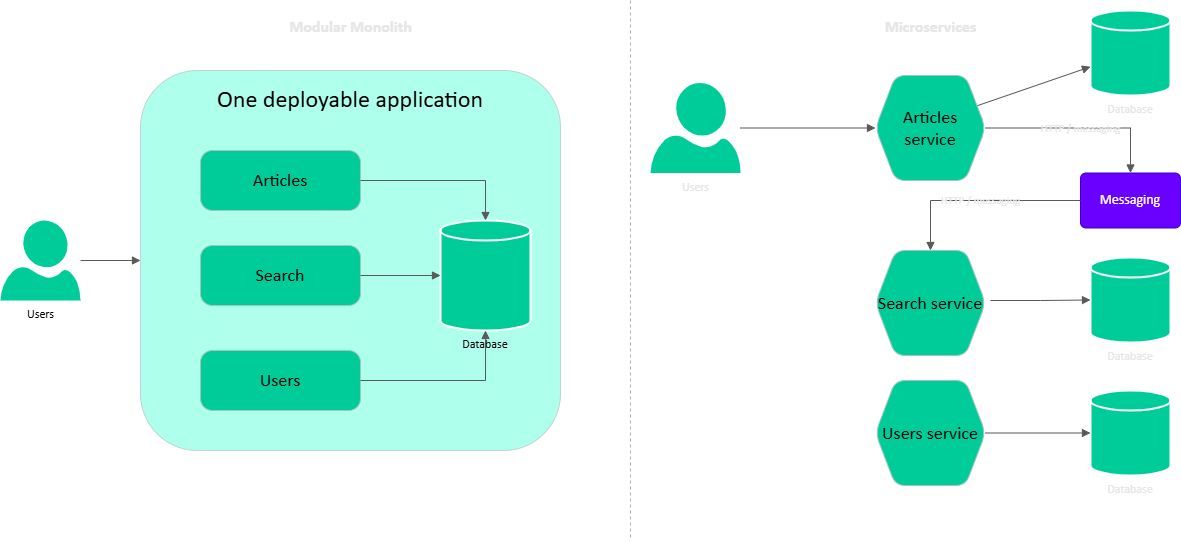
In simple terms, one application can contain article management, search and user administration, but these areas should still have clear code ownership and interfaces. Monolith does not mean unstructured code. A modular monolith can be a healthy starting point.
What are microservices?
Microservices are independently deployable services organized around business capabilities, with explicit communication and operational boundaries.
Simply put, article publishing and search may be separate services, each owned by a team and communicating through APIs or messages. The separation provides freedom, but every network boundary adds failure and monitoring work.
Why the choice is important?
The architecture changes the team’s day-to-day work. A customer does not care whether the application has ten services, the customer cares that an article opens quickly and a publish action is reliable. We should choose the design which lets us make the right changes with sustainable operational effort.
The following diagram depicts a modular monolith and a microservice decomposition,
Comparison
| Concern | Modular monolith | Microservices |
|---|---|---|
| Deployment | One release unit | Several independent releases |
| Communication | In-process calls | HTTP or messaging |
| Data | One database may be shared | Each service should own its data |
| Failure | Mostly local failures | Timeouts and partial failures |
| Scaling | Scale the application | Scale selected services |
| Operations | Simpler initially | Requires mature monitoring and automation |
| Team ownership | Modules within one team or group | Strong service ownership boundaries |
Where microservices help?
Microservices can help when one business capability changes at a different speed, needs independent scaling, or must be owned by a team with a clear boundary. A search indexer may scale differently from article editing and can process messages asynchronously. A service can also isolate a technology decision which the main application should not absorb.
The benefit is not free. We need service discovery, deployment automation, health checks, tracing and a plan for data consistency. A user request which crosses three services has three places to diagnose. Without observability, the architecture creates more blind spots than it removes.
Where a monolith helps?
A monolith provides a simple transaction boundary and a fast feedback loop. A small team can change a workflow, run tests and deploy one artifact. It is easier to start with a single database while the domain is being learned, provided modules do not access each other’s tables without a contract.
Avoid the “big ball of mud” by defining module ownership, keeping controllers thin, and making dependencies visible. The code can then be extracted later if the business pressure justifies it. Extraction from a modular boundary is less painful than extraction from a shared collection of static helpers.
Worked modular monolith example
Find below one way of keeping capability boundaries inside one ASP.NET solution,
News.Application
  Articles/ArticleService.cs
  Search/ArticleSearchService.cs
News.Domain
  Articles/Article.cs
News.Infrastructure
  Articles/SqlArticleRepository.cs
News.Web
  Articles/ArticlesController.cs
  Search/SearchController.cs
The Article module is exposing an application service and is not allowing Search to query its private tables directly,
namespace News.Articles
{
    public sealed class ArticleService
    {
        private readonly IArticleRepository repository;

        public ArticleService(IArticleRepository repository)
        {
            this.repository = repository;
        }

        public ArticleSummary Get(int id)
        {
            Article article = repository.Find(id);
            return article == null
                ? null
                : new ArticleSummary(article.Id, article.Title);
        }
    }
}
The search module can call a contract or use a read projection, but it should not reference the Article Entity Framework DbContext. It means we are having one deployable unit, while the business boundaries are already visible. If a module is extracted later, the contract is ready for the new boundary.
Signals to extract a service
Let us discuss the signals which are telling us that a module may be ready for extraction,
- The capability is having an independent owner and release cadence.
- Its workload is requiring a different scale profile which has been measured.
- Its data ownership is clear and it is not joining another service’s tables.
- The team is having monitoring, deployment and on-call capability for the service.
- The network contract is stable and retries are idempotent.
- The module can tolerate eventual consistency where it is being introduced.
If these signals are not existing, splitting the code is only creating distributed complexity. A service call can time out after the remote update is completed, and a retry can create duplicate work. We should first keep a modular monolith, measure the pressure and extract one capability for a clear reason.
After extraction, the team is owning more than code. It is owning deployment, health checks, alerts, capacity and a support process. If the service is failing and nobody knows which team is responsible, the customer is finding the boundary before the organization is ready. A proactive service checklist should be completed before extraction, and the decision should be revisited when the measured pressure is changing.
Must Do and Don’ts
- Must Do: Keep module dependencies explicit, because hidden table access is coupling.
- Must Do: Give each module a clear owner and test boundary.
- Don’t: call another service for every small in-process operation when a module is enough.
- Don’t: split a service before its data ownership is clear.
- Be mindful: A service boundary is also a failure boundary and an operational responsibility.
Without clear boundaries, we are reacting to a large monolith which nobody is understanding. Without operational readiness, we are reacting to timeouts and duplicate messages across many services. We should be proactive by making a modular monolith first and measuring the pressure, then choosing the trade-off between simple deployment and independent scaling based on our context.
Should we start with microservices?
Normally, start with a modular monolith unless we have a known boundary, independent scaling requirement and operational maturity. Define the modules around business capabilities, keep APIs between them explicit, and measure build time, deployment frequency, load and failure patterns. When one module becomes a bottleneck, extract it with a clear contract.
If the system is already distributed, make every call timeout-aware and idempotent where possible. A retry without idempotence can create duplicate articles or notifications. Keep this in mind while comparing the architecture: a service boundary is also a failure boundary.
Wrap up
In this article, we have looked at monoliths, microservices, modular boundaries, extraction signals, scaling, team ownership and distributed failure. I hope this article provided you some insights into choosing an architecture. In the next article, I will walk you through Domain-Driven Design, bounded context and ubiquitous language.
Related Posts
Microservices - Part 1
Microservices Part 1 explains Conway's Law, modular monoliths, service ownership, distributed data, deployment independence and the hidden costs of service boundaries.
What is CQRS - separating reads and writes, and when not to use it?
CQRS explained through commands, handlers, queries, read models, eventual consistency, and the situations where separating reads and writes is unnecessary.
Event Sourcing - storing the history, not just the state
Event Sourcing explained through state versus event history, commands, aggregates, append-only stores, projections, snapshots and versioned events for practical guidance.