What Lift-and-Shift Actually Meant in 2020 (And Why Most Teams Got It Wrong)
Why 2020's lift-and-shift playbook was a datacenter exit strategy mislabeled as cloud migration — and the four hidden taxes teams are still paying for it.
What Lift-and-Shift Actually Meant in 2020 (And Why Most Teams Got It Wrong)
Rehosting was sold as a migration strategy. It was actually a hosting decision dressed up as one.
TL;DR: Lift-and-shift was sold to enterprises in 2020 as a migration strategy. It was actually a calendar decision dressed up as one — a way to exit a datacenter, not a way to enter the cloud. Teams that named it correctly negotiated the trade-offs in advance and scheduled the second half of the work; teams that didn’t are still paying the bill years later. This piece walks through what lift-and-shift actually meant, the four hidden taxes nobody priced into the business case, how to tell on Day 30 whether you got it right, and what to put on the calendar before you sign the migration off as “done.”
One slide, three adjectives, a six-week debug
Open any 2020 cloud-migration deck and you’ll find the same slide. Lift-and-shift: move the workload to the cloud as-is. Fast. Low risk. Cost-effective. One line, three adjectives, next slide.
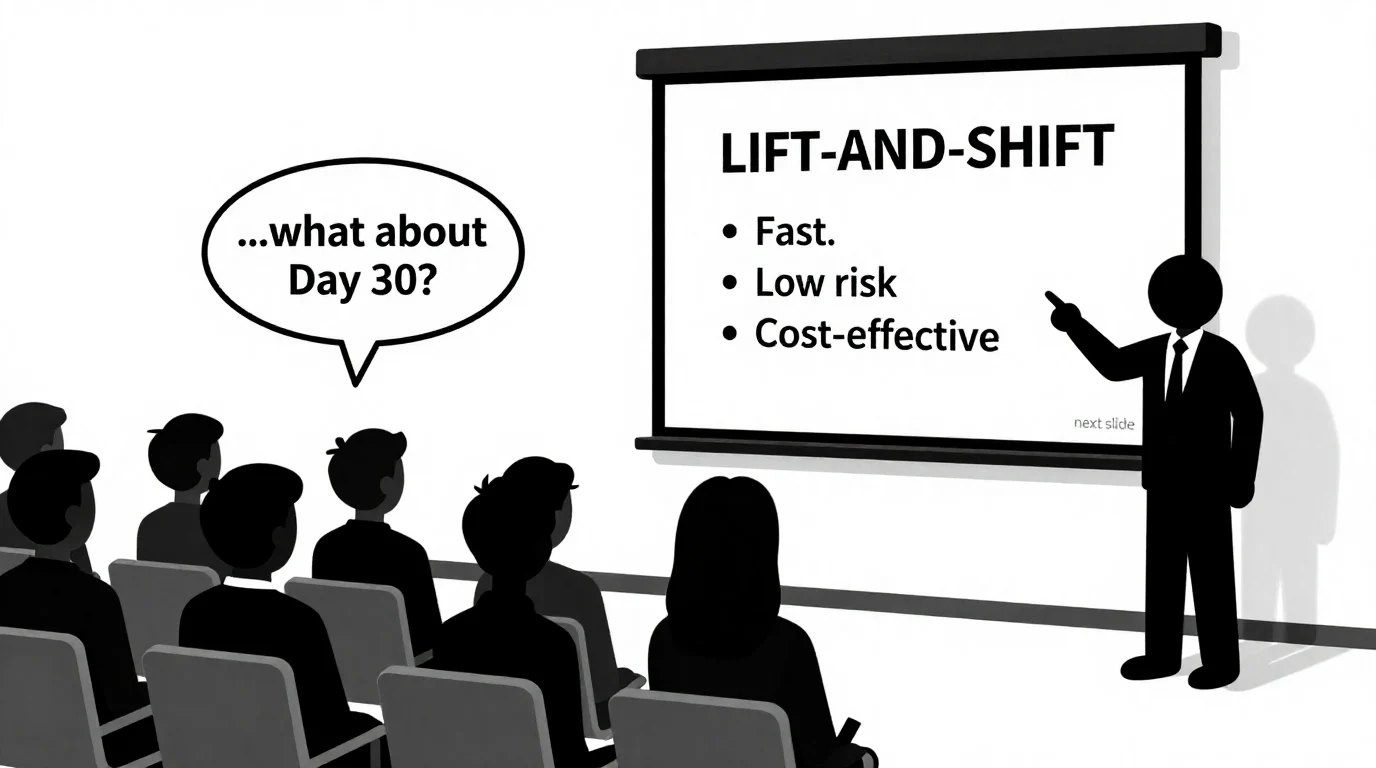
That single slide is where most 2020 cloud programs quietly went wrong.
Not because lift-and-shift is a bad idea. It isn’t. It’s a perfectly reasonable choice — for a narrow set of workloads, on a specific calendar, with a named follow-up plan. The problem is that the slide stripped all three qualifiers off and replaced them with the word “fast.”
The scene that played out in a thousand teams
It’s a Tuesday in February 2020. You’re a tech lead. The cloud program manager stops by your desk (back when desks were a thing) and tells you the order-management service has been added to the Q1 migration wave. The plan is lift-and-shift. Two-week effort. The infrastructure team will provision the Azure VMs, your team re-points the connection strings, QA does a smoke test, and we cut over on a Saturday night.
The migration goes fine. The Saturday cutover goes fine. Monday morning the dashboards are green.
By Wednesday, three things have happened:
- The Azure bill is 32% higher than the on-prem bill — and you can’t explain why
- Page-load times in production have increased by ~140 ms — and the customer-experience team has noticed
- A scheduled SQL Agent job didn’t run because nobody was thinking about it during the migration, and a downstream report is now wrong
You’re going to spend the next six weeks debugging those three things. Nobody on the migration steering committee will call that “still part of the migration.” Officially, the migration is done.
This is what lift-and-shift actually felt like in 2020. The plan was always honest about the move. It was almost never honest about Day 30.
The tension nobody priced in
Lift-and-shift is sold as a risk-reduction strategy: don’t change the app, don’t change the database, don’t change the integrations — just change where they run. On paper, this is conservative.
In practice, it transfers risk from the project plan to the operating budget. The migration looks safe because the scope is narrow. But the things you didn’t change still have to operate in an environment with different physics:
| Layer | On-prem assumption | Cloud reality |
|---|---|---|
| Networking | Chatty east-west traffic is free | Every hop is egress, ExpressRoute, and measurable latency |
| Storage | SAN gives “all the IOPS you want” | Managed disks meter every IOP; throttle counters light up |
| Licensing | SQL/Windows/agents covered by datacenter ELA | Re-baselined under cloud terms — sometimes much more expensive |
| Identity | Active Directory is ambient | AD trusts, service accounts, Kerberos all need a Terraform module |
Each row is a tax. None of them appears on the migration plan. All of them show up in the first 30–90 days after cutover, distributed across teams that weren’t part of the migration project, billed against budgets that weren’t briefed.
This is the gap between “the migration succeeded” and “the customer experience is the same or better.” Lift-and-shift, as marketed in 2020, lived entirely in the first sentence.
The insight: lift-and-shift is a calendar decision, not an architecture
Here’s the reframe that changes everything.
Lift-and-shift is not a cloud strategy. It’s a datacenter exit strategy. It answers the question, “How do we get out of this physical building by [date]?” — not the question, “How should this workload run for the next ten years?”
Once you say it that way, the entire conversation changes. The trade-offs get honest. The follow-up work gets scheduled. The bill gets explained.
The cloud-migration “6 R’s” framework — Rehost, Replatform, Repurchase, Refactor, Retire, Retain — exists precisely to make this reframe operational. (Originally Gartner’s 5 R’s in 2011, extended by AWS’s Stephen Orban in 2016 to add Repurchase.) Rehost is one of six choices, sized for one specific scenario: a workload that has to move on a deadline, and where the cost of any deeper change exceeds the cost of moving twice. Twice. That word is doing a lot of work. The framework has always assumed that if you rehost, you’ve also signed up to replatform or refactor later — once the calendar pressure is off.
Most 2020 enterprise migrations skipped that second commitment. The migration committee declared victory at cutover and disbanded. The replatform-later was nobody’s job. And so the rehosted workload became the permanent workload, with all four taxes compounding quietly in the background.
That’s the whole story. Not a technology failure. A commitment failure.
What to actually do differently
You don’t fix this with a better runbook. You fix it with three small structural changes that any tech lead can put in place before the next migration wave.
1. Name the horizon explicitly in the migration ticket. Every migrated workload gets one of three labels:
H1: Datacenter exit— pure rehost, no further plan, this is the final state. Used only for workloads scheduled to retire within 18 months.H2: Replatform on the schedule— rehost first, with a named replatform sprint within 6 months and a budget owner.H3: Refactor pending— rehost is temporary scaffolding; the refactor is on the roadmap, with a sponsor.
Workloads with no label don’t get migrated. The label forces the conversation about what comes after the cutover before the cutover.
2. Pre-fund the four hidden taxes. Add a line item to the migration budget — usually 15–25% of the rehost cost — explicitly tagged as “post-cutover optimization.” Networking, storage tier review, licensing re-baseline, and identity rewiring. If finance asks what it’s for, you have a real answer instead of a surprise bill in month 3.
3. Schedule the Day-30 review on the cutover day itself. Not “we’ll check in next quarter.” A specific calendar invite, 30 days from cutover, with the four taxes as the agenda. The teams that did this in 2020 caught the surprises early. The teams that didn’t are still finding them.
That’s it. Three changes. None of them require a new tool or a new vendor. All of them require the political will to admit, at the start, that lift-and-shift is half a migration.
How to measure or confirm
You’ll know whether your lift-and-shift was honest within the first 30 days. Five signals to watch:
- Cloud-bill delta vs forecast. If the actual Azure bill is more than 15% above the rehost forecast, one of the four taxes is hitting you. Most likely storage IOPS or egress.
- P95 latency delta on the top three customer journeys. If P95 went up by more than 50 ms, you’ve got a network-topology problem the migration didn’t surface.
- Number of “we didn’t realize” tickets in the first 30 days. Scheduled jobs that didn’t run. Agents that don’t exist in the cloud image. Network paths that worked through the on-prem firewall but are now blocked. Count them. Anything above five is a signal that the migration scope was lying.
- Identity / auth incidents. Service-principal expiration, Managed Identity not yet enabled, Kerberos delegation not configured — these almost always show up between Day 7 and Day 21.
- Whether anyone owns “post-migration optimization.” This is the single biggest predictor. If the answer to “who’s responsible for the replatform follow-up?” is silence, you’ve got an H1 workload that was sold as H2.
Three patterns that kept repeating
Across 2020 lift-and-shift programs, the same three failure modes showed up regardless of industry, team size, or cloud vendor:
- “We’ll optimize next sprint” — and never do. The follow-up sprint never gets prioritized because the workload is running, and “running” beats “optimal” in every quarterly planning session. The fix: put the optimization sprint on the migration program’s gantt, not the product team’s backlog.
- The migration team disbands at cutover. All the institutional memory of why each decision was made walks out the door with them. The fix: the migration tech lead stays embedded with the product team for 30 days post-cutover, paid out of the migration budget.
- No baseline measurements. Teams couldn’t tell whether things got worse because they never measured before. The fix: capture P95 latency, error rate, and a representative cloud-cost projection before the cutover. Without those numbers, every Day-30 incident becomes an argument instead of a diagnosis.
Takeaway
Lift-and-shift was never wrong. It was just under-described. As a tactic for exiting a datacenter on a deadline, it’s still the right answer in 2020 — for the workloads it actually fits.
What broke in 2020 was the discipline around the second half of the work. The cloud business case promised an architecture. The migration plan delivered a hosting change. The two were treated as the same thing.
If you’re reading this in the middle of a 2020 migration wave — or auditing one years later — the question isn’t was lift-and-shift the right call? The question is: for each rehosted workload, do we have a named owner, a budget, and a calendar date for the half of the work that didn’t happen yet?
If yes, you ran a migration. If no, you ran a relocation, and the bill is still arriving.
“You don’t migrate by moving the VM. You migrate by moving the assumptions.”
The networking model changed. The storage economics changed. The identity surface changed. The license terms changed. So if the only thing that actually moved was the binary — what exactly did you migrate?
Related Posts
Why Lift-and-Shift Created More Problems Than It Solved
Why rehosting can move technical debt and hidden costs to Azure, and when a broader migration strategy is needed.
Rehosting vs Replatforming: The Architectural Blind Spot
A decision framework for choosing rehosting, replatforming or deeper change based on cloud benefits, team capacity and workload needs.
The Hidden Cost of "Just Move to Azure" Decisions
The hidden costs of a just-move-to-Azure decision, including dual-running, skills gaps, cloud pricing and ungoverned sprawl.